
Exercise Report : Macedonian Air Force CSAR/MEDEVAC Exercise

|
|
|||||||||
|
Igor Bozinovski
reports on the CSAR and MEDEVAC exercise held by the Macedonian Air Force in preparation for
its first international deployment in support of Operation ALTHEA in Bosnia.
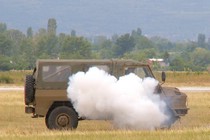
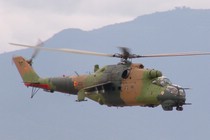
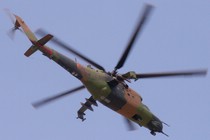
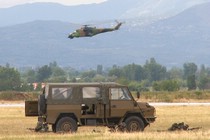
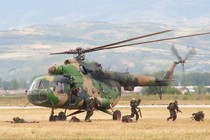
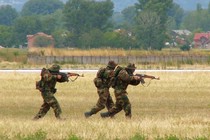
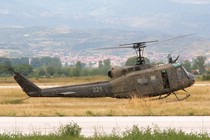
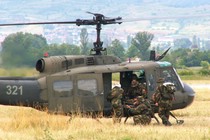
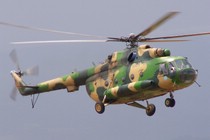
Macedonian Air Force exercises before its first foreign deployment On June 10th, 2006, the Macedonian Air Force (Makedonsko Voeno Vozduhoplovstvo) celebrated its 14th anniversary with a big exercise intended to demonstrate the young air arm's capabilities to perform complex combat missions in areas under enemy or unfriendly control and when operating within multi-national missions. The event that took place at Petrovec Air Force base, near Skopje, was indeed one of the final checks for the Macedonian Air Force before its first real deployment abroad of two Mi-17 helicopters to Mostar air base, Bosnia and Herzegovina, as a part of EU-led crisis management Operation ALTHEA. Scenario Under the exercise scenario, Macedonian Army contingent composed of Air Force flight (with five helicopters: two Mi-17s, two Mi-24Vs and one UH-1H) and a company-size special forces troop contingent have been deployed to a country called North Felix as part of multi-national mission for conducting Peace Support Operations (PSO). The Macedonian contingent is operating within Multinational Task Forces “East” that is responsible to keep the warring factions apart as part of a PSO. One day, a team of Macedonian soldiers gets the order to perform a recon mission in the so-called Saphir area, where the biggest reserves of water are located. While on a mission, one of the Macedonian Army vehicles hit an anti-tank mine, injuring two of the soldiers, one of them seriously. At the same time as their vehicle hits the mine, Macedonian soldiers face heavy fire from a much larger rebel force. Faced with the danger of his soldiers to be surrounded and eventually killed, the unit commander contacts the HQ of the Multinational Task Forces “East” requesting immediate reinforcement as well as medical evacuation for his wounded soldiers. Combined CSAR and MEDEVAC In response to the commander’s request for assistance, the HQ of Multinational Task Forces “East” orders the Macedonian helicopters to take-off and perform combined CSAR (Combat Search and Rescue) and MEDEVAC (Medical Evacuation) in support of soldiers under fire. Once the order has been received, a group of four Macedonian Air Force helicopters departs their base on way to the problem area. The helicopters group is lead by two Mi-24 gunships, followed by one MEDEVAC-configured UH-1H as well as one Mi-17 with six soldiers and two flight medics on board. Upon arriving close to the scene of the fight, the two Mi-24 helicopters flying low and fast enter into the combat zone exploring the scene of the fighting and performing identification of friendly and enemy forces on the ground. Once the enemy forces have been identified, Macedonian Mi-24s apply direct force against the enemy positions. Following the engagement one of the helicopters remains on the scene providing protection for the friendly forces, while the other gunship leaves the combat zone in order to escort the airborne Mi-17 helicopter waiting to enter the combat area. Protected by the Mi-24 gunship, the Mi-17 transport helicopter enters the combat zone and lands near the friendly troops, disembarking the reinforcement package composed of six soldiers and two flight medics. The Mi-24 joins the other Mi-24 in providing protection for the troops on ground. Once the reinforcement package was on the ground, the Mi-17 helicopter leaves the combat zone through a safe corridor to wait for the next order. By that time, the soldiers that have arrived with the Mi-17 helicopter join the troops on ground while the flight medics have started treatment of those injured and prepare them for evacuation. Once everything is ready for the evacuation, the UH-1H helicopter enters the combat zone and picks up injured soldiers and flight medics that are immediately flown to the nearest hospital. Once the UH-1H is out of the combat zone, the Mi-17 helicopter again enters the combat zone where it picks up all the remaining soldiers and departs on its way to the base protected by the Mi-24V helicopters. Macedonian Air Force reforms Following the end of the 2001 security crisis, the Republic of Macedonia initiated profound military reforms intended to permanently eliminate all the weaknesses that Cold War-era structured defence system showed during the 2001 hostilities as well as to speed up the process of fulfilling conditions necessary for achieving the full member status within NATO. More precisely, the reforms for transformation of the Macedonian Air Force are intended to provide new command and control model that should secure unified hierarchy as well as simplicity in the system of commanding and managing. In addition to this, following the completion of the defence reform process, ongoing modernization projects and upcoming purchases of new aircraft, the Macedonian Air Force shall become a small, mobile and professional force that will be trained, equipped and well prepared according to the NATO standards. The first real test of this concept will be the upcoming deployment of two Mi-17 helicopters to Bosnia and Herzegovina starting from July 2006. The plan calls for six-month long deployment of the two helicopters to Mostar air base as part of EU-led crisis management Operation ALTHEA - Multinational Task Force South-East / Task Force Salamander. Apart from testing its overall compatibility with NATO and EU forces, the deployment of Mi-17 helicopters in Bosnia will also make history since it will be the first ever international mission for the Macedonian Air Force. |
Text & photos copyright Igor Bozinovski (contact by e-mail)
First Published: 25 June 2006
Last Modified: 22 March 2013
Last Modified: 22 March 2013
Home | Aircraft | Air Forces | Air Shows | Specials | Wallpapers | News | Quiz | Forum
Contact | About | FAQ | Updates | RSS Feeds | Links | Search
 Back to Index
Move to Top
Back to Index
Move to Top 
Copyright © 2002-2024 Niels Hillebrand. All Rights Reserved | Privacy & Cookie Policy | Terms of Service

