
Photo Report : Hochgebirgslandekurs
|
|

|
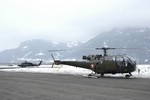
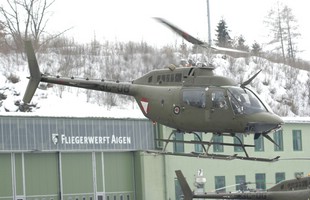
Helmut Skrdla reports on the 2006 Hochgebirgslandekurs, the Austrian specialized helicopter-flying training course in the high and snowy Alpine region. Austria is, just as the national anthem says, a "land of mountains" - far more than for most EU-Neighbours wide regions of the country are situated in alpine heights of up to 3000 meters and more. Looking at this geographical situation, it is easy to understand why austrian helicopter crews have refined their skills in high altutide flying to a fine art, which warrants their international recognition as experts in this terrain. The teaching of this very special and for safe flight operations essential knowledge is the goal of the so-called “Hochgebirgslandekurs" (HGL - translates literary to “high mountain landing course”) which is held two times per year, one each in summer and winter. Topics covered span from learning about the physical and psychological demands while flying “on the edge”, to knowledge about weather- , snow- and avalanche conditions, selection and safe approach of landing spots, as well as parking and securing of the aircraft, up to night landing exercises in alpine territory. All these areas are first taught in theory and then repeatedly exercised “in the field”, usually with a senior pilot on the left seat.
These courses are also the formal conclusion to the training program for “mission capable” helicopter pilots
in the Austrian Air Force (AAF) which can be roughly outlined as follows:
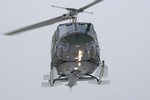
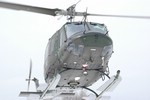
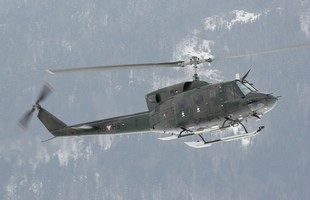
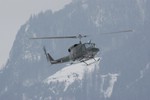
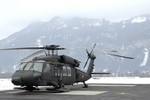
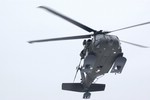
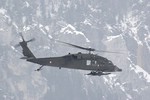
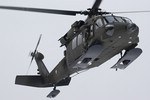
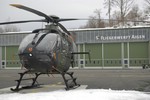
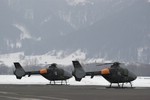
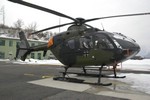
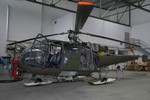
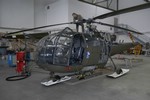
Next follows a series of training flights, dealing with landings “out in the field”, nap-of-the-earth- and formation-flying, as well as the first simple missions being tasked out to the new pilot. Only after about 30 months in the operational unit and around 600 flight hours, the pilot is sent on the HGLs, where completion of both (summer and winter) courses is mandatory before the airman is finally considered “fully mission capable”. Even then, the pilot still occasionally flies with a more experienced officer to polish off the pilot's skills on the job. Each HGL is open for all units, so it is not uncommon to find all the different helicopter types used in the AAF at once on these events. Because there are always one or two pilots in each Staffel who need to complete the courses. Taking part in the HGL which was visited by the author (Winter 2006), held at Airbase Fiala-Fernbrugg near the village of Aigen, were one S-70 Blackhawk and a few OH-58 Kiowas from FR1, multiple Agusta-Bell 212 (UH-1N) from FR3 in Linz-Hörsching, and of course many Alouette III from the so-called “Helicopter Squadron” which has its home in Aigen. As an interesting side note, this squadron currently operates three Alouette III at Tuzla in Bosnia under command of EUFOR. They are tasked with the primary missions of transport and reconnaissance. In the mountainous, forested and mostly pathless terrain there the experience of Austrian aircrews really pays off. It are not just local airmen who benefit from the HGL-training – for years now the AAF has welcomed regular visitors from various European countries and the United States, who also want to practice and refine their high-altitude flying skills. It is interesting to note that because of the general increase in foreign military deployments (for example to Afghanistan as part of the the 'War on Terror') suddenly countries with no traditional requirement for alpine helicopter skills (for example the UK) find themselves in a situation were exactly these skills can save lives. And besides Switzerland, which has stopped almost completely to invite guests to their similar courses, Austria is the only European nation with an Air Force well-experienced in this terrain and willingness to teach. Currently, one of the best cooperations exsists with the American UH-60 pilots from Oregon – they practice flying in mountainous regions here and in return teach AAF crews flying by night with NVGs, which is still a very new topic for the Austrian pilots. The Heeresfliegerwaffenschule Bückeburg (German Army Pilots & Weapons School in Bückeburg) also regularly takes part in the HGLs. In a “train the trainer” system, they send their own instructors here to practise high altitude flying, so that they can then teach their students at home. By now, German helicopter pilots have already been deployed on foreign operations, taking with them the knowledge which their instructors obtained at the Austrian HGLs.
It is certainly good to see such a high level of international cooperation taking place here in this small
country. Hopefully many more national and international aircrews will earn their
'alpine wings' on the Austrian training courses.
With special thanks to ADir. Rudolf Thumfarth and Obst. W. Eberle for the invitation to the March 2006 HGL, as well as to Georg Mader for the parts of his interview with the German Obst. Grube that have gone into this text. |
|
||||||||||||||||||||||||
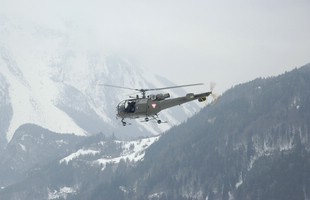
Report and photos by Helmut Skrdla ( view portfolio )
Last Modified: 28 March 2013
Home | Aircraft | Air Forces | Air Shows | Specials | Wallpapers | News | Quiz | Forum
Contact | About | FAQ | Updates | RSS Feeds | Links | Search
 Back to Index
Move to Top
Back to Index
Move to Top 
Copyright © 2002-2026 Niels Hillebrand. All Rights Reserved | Privacy & Cookie Policy | Terms of Service

