
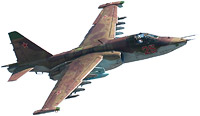
Sukhoi Su-25 'Frogfoot'
Role: Close Air Support, Ground Attack, Combat/Naval Trainer
Origin: Russia
Design: Sukhoi Design Bureau
Production: Tbilisi Aerospace Manufacturing (TAM), Georgia
Ulan-Ude Aviation Plant, Russia
Variants: Su-25 (Frogfoot-A), Su-25K (Frogfoot-A), Su-25BM/BMK (Frogfoot-A), Su-25UB/UBK (Frogfoot-B), Su-25UT (Su-28, Frogfoot-B), Su-25UTG (Frogfoot-B), Su-25T/TM (Su-39), Su-25TK (Su-34), Su-25SM, Su-25UBM
Operators*: Russia, Angola, Armenia, Azerbaijan, Belarus, Bulgaria, Chad, Congo, Czech Republic, Equatorial Guinea, Ethiopia, Gambia, Georgia, Iran, Iraq, Ivory Coast, Kazakhstan, Macedonia, North Korea, Peru, Slovakia, Sudan, Turkmenistan, Ukraine, Uzbekistan
*past and present
The Su-25 'Grach' (Rook), NATO callsigned 'Frogfoot', is a dedicated strike attack aircraft designed for the Close Air Support and Anti-Tank roles. The Su-25 is designed to withstand heavy enemy fire relying on the heavily armoured airframe and cockpit, seperated engine bays and foamed internal fuel tanks. The design sacrifised speed for low-level maneuvrability, low-speed handling and weapons accuracy. A special design feature are the wingtips which split at the rear to form airbrakes, this to furthur improve low-speed handling. The nose houses a laser rangefinder which also acts as target designator. Above the tailcone at the back of the aircraft is a Sirena-3 radar warning system located.
First production variant was the Su-25 (NATO Frogfoot-A), the Su-25K being the first export variant of the type. While Warsaw Pact Su-25Ks resembled early Su-25 models both externally and internally, the Su-25Ks exported to Iraq and North Korea had downgraded avionics and fire control systems. The Su-25BM (Su-25BMK for export) is a modified variant of the Su-25 (Frogfoot-A) capable of towing aerial targets for air-to-air and ground-to-air gunnery training. The internal cannon was deleted.
The Su-25UB Frogfoot-B (Su-25UBK for export) is the two-seat trainer variant developed as a combat transition trainer for the Russian Air Force. The Su-25UB/UBK is equipped with the same avionics and systems as the Su-25 Frogfoot-A and is fully combat capable and able to use the same ordnance. Again Su-25UBKs exported to non-Warsaw Pact countries were equipped with downgraded avionics and fire control systems.
Development of the Su-25UB as an advanced trainer for the Russian Air Force led to the unarmed Su-25UT two-seat trainer, which is also known as Su-28. The cannon, armor, fire control systems, ECM systems and all other combat equipment was deleted, as well as five of the hardpoints and the chaff/flare dispensers. Although intended to replace the L-29 Delfin and L-39 Albatros trainers it never did.
The Su-25UTG is a navilized version of the Su-25UT trainer which was used to familiarize Navy pilots with carrier procedures. One Su-25UT was converted to Su-25UTG, the major change being the braking parachute being replaced by the arrester hook. No more were built.
The Su-25TM, also known as Su-39, is improved version of the Frogfoot based on the Su-25UB combat trainer. Avionics and systems were considerably upgraded, making the aircraft capable of conducting missions at night and under all weather conditions. The main role of this variant is the Anti-Tank role. The weapons systems also allow the Su-25TM or Su-39 to be used in the Anti-Ship role and has a limited air-to-air combat capability against helicopters and other low speed aerial targets. Survivability is increased using additional armor, reduced infrared signature, chaff/flare dispensers, IR jammer and more RWR antennas. System upgrades include auto pilot, better nav/attack systems and sensors, Low Light Level Television/Forward Looking Infra Red (LLTV/FLIR) pod, cockpit displays, wide-angle HUD. Production will depend on export orders. The Su-25TK and Su-34 were proposed designations used for the export version of the Su-25TM. The Su-34 designation was later re-used for the Su-27IB Flanker.
The Su-25SM is the designation used for upgraded standard production Su-25 single-seat aircraft, and Su-25UBM the designation for a similar upgrade for the Su-25UB. The upgrade is carried out by the 121 ARZ plant at Kubinka Air Base. In 2001, the first Su-25SM was completed followed by a second aircraft in 2003. The test programme was completed in 2005, and the 121 ARZ started series upgrade of the Russian Air Force Su-25 fleet. The first six aircraft were completed in 2006 and handed over to the Russian Air Force on December 28, 2006. They received new serials; side number 01 thru 06. Six more Su-25SMs are scheduled for delivery in 2007, and eight for 2008. Two attack regiments will convert to the Su-25SM, starting with the 368th Attack Aircraft Regiment at Budyonnovsk.
Main element of the Su-25SM upgrade is the new PrNK-25SM nav/attack system with satnav receiver, colour multi-purpose LCD, and SUO-39 fire control system. The upgrade is claimed to offer two to three times greater accuracy in weapons delivery and up to ten times in navigation accuracy. The upgrade also replaced the obsolete RWR with the L-150 electronic intelligence station and enables the use of R-73 advanced IR guided air-to-air missiles and KAB-500Kr TV-guided bombs.
Work on the upgrade of the first Su-25UB two-seat combat trainer to Su-25UBM standard in a similar upgrade started in May 2005 according to AFM, but recently it is reported it is planned for 2007.
The Su-25KM 'Skorpion' is a Su-25K upgrade offered by the collaboration between Elbit Systems and Georgia's TAM (Tbilisi Aerospace Manufacturing). Improvements include Multi Function Color Displays, new HUD, Elbit Mission Computer, and an optional Helmet Mounted Display. On 27 October 2004, the first Su-25KM Skorpion was delivered to the Turkmenistan Air Force. This makes the Turkmenistan Air Force the first customer for the new variant. Georgia had already overhauled 43 standard Su-25s for Turkmenistan as a part payment for Georgian debts for the supply of gas, which is also believed to be the payment for the Su-25KM delivery.
Five Iraqi Su-25K and two Su-25UBK Frogfoots fled to Iran during Operation Desert Storm in 1991. Last year two of these Su-25Ks entered service with the Islamic Revolutionary Guards Corps Air Force (IRGCAF), after having been refurbished with help from Georgian technicians. The IRGCAF also has ordered about 30 Su-25UBK two-seat combat trainers from Russia's Ulan-Ude Aviation Plant.
-
Sources:
- Su-25 Frogfoot in action (ISBN 089747287X)
- Air Forces Monthly, December 2004, Key Publishing Ltd, UK.
- Air Forces Monthly, March 2007, Key Publishing Ltd, UK.
- Interfax-AVN, 25 July 2005
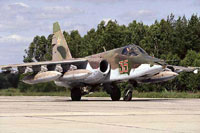
Russian Su-25 'Frogfoot-A'
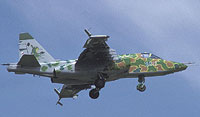
Su-25K exported to Czech Republic
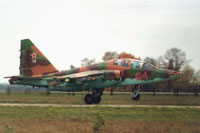
Su-25UB 'Frogfoot-B' combat trainer
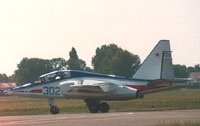
Su-25UT or Su-28 proposed trainer
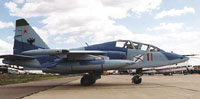
Su-25UTG navalized trainer
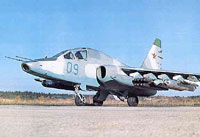
Su-25TM or Su-39 improved Frogfoot
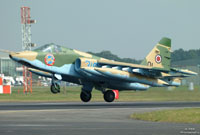
Su-25KM 'Scorpion' upgrade
 Back to Index

