
Sukhoi Su-32/Su-34 Platypus
Role: multi-role tactical bomber
Builder: Sukhoi, NAPO
Variants: Su-32/Su-34 (T-10B, Su-27IB), Su-32FN, Su-34MF, Su-27R, Su-34P (Su-27IBP)
Operators: Russia
Su-27IB Bomber Flanker
In 1983 the first conceptual design for a new tactical bomber was made. The new aircraft was planned to replace the third generation fighter-bombers and tactical bombers; the Su-17, MiG-27, Su-24 and their derivatives, in the 1990s. The Su-27 would serve as the basis for the new aircraft, designated Su-27IB (factory designation T-10V). IB standing for Istrebitel-Bombardirovshchik or fighter-bomber. The Su-27IB incorporates the heavy payload and combat radius of the tactical bomber and the high manoeuvrability and speed of the fighter, so it could be deployed against ground, naval and also airborne targets. In this view, the Su-34 can be compared to the US F-15E Strike Eagle, which was also developed from a successful and agile fighter into a multi-role tactical strike aircraft.
New Cockpit Design
The design was considerably changed from the basic Su-27/Su-27UB. To improve interoperability between the pilot and navigator, the cockpit arrangement was completely changed by side-by-side placed K-36DM ejection seats (as on the Su-24 tactical bomber). In addition the cockpit has been pressurized. The crew is able to lie down or prepare some food in the area behind the cockpit. To improve sanitary conditions the aircraft has also been fitted with a toilet. The cockpit is accessed via a hatch and ladder in the front nosegear well, which was placed more forward and is retracted backwards into the well.
Airframe Changes
To accomodate the new cockpit configuration, additional equipment and increased fuel internal fuel load, the fuselage has changed drastically. The nose section is shaped elliptical, which gave the aircraft the nickname 'Platypus'. The fuselage midsection has been changed to accomodate the increased size No 1 fuel tank. The engine intakes were changed from variable to fixed geometry air intakes. Also the rear of the aircraft underwent changes in the shape, the most recognisable is the new enlarged central tailboom. The wing panels and canards of the Su-27M were adapted for improved flight characteristics and larger fuel cells. All these changes ment an 1.5 increase of the take-off weight. The maximum take-off weight increased from 28 tonnes of the basic Su-27 to 45 tonnes. To cope with the increased weight the mid section was strengthened and a new undercarriage was fitted, the main landing gear single-wheels have been replaced by two wheels placed in tandem.
Fighter-Bomber Avionics
The aircraft carries a multifunction phased array radar and built-in IRST/sighting system with incorporated TV and laser detection and guidance capability. A thermal imaging system for night operation would however be carried externally. Also the aircraft has been fitted with powerful ECM equipment and a rearward-looking radar, like the Su-35. The new systems ensured day and night, all-weather capability against both surface and airborne targets.
Fighter-Bomber Weapons
The Su-27IB can carry a large arrange of weapons. The air-to-air weapons inventory consists of Russia's modern air-to-air missiles, such as the RVV-AE, R-73 and derivatives of the R-27 missile. For ground targets the aircraft is capable of both guided and unguided weapons. Guided weapons include the Kh-29, Kh-25, Kh-59M missiles as well as KAB-500 TV/laser and KAB-1500TK TV/command guided bombs. Unguided weapons include 1,500, 500, 250 or 100kg bombs, rockets and rocket pods. Against maritime targets the aircraft can carry up to six Kh-31A or Kh-35 anti-ship missiles. Against enemy air defenses six Kh-31P passive radar homing anti-radiation missiles can be carried.
Su-34, Su-32FN and Su-32MF designations
As common with Su-27 derivatives, also the Su-27IB
has been given an alternative
designation by Sukhoi and aviation press. The Su-27IB has also been known
as the Su-34 since its maiden flight.
When however the Su-34 was sent to its first
international airshow, Le Bourget in 1995, the aircraft was given the designation
Su-32FN. This commercial designation was adopted by Sukhoi, to stress the aircraft's
potential as a shore-based maritime patrol and strike aircraft for potential export
customers in search of a fast aircraft to be deployed against ships and submarines.
The design called for special equipment and weapons to detect and destroy waterborne
targets. No customer have been found yet, and the specific variant has remained on the drawing
board.
In 1999, the Su-34 was now presented as Su-32MF on the MAKS 1999 Moscow International
Air Salloon. This time to stress its multi-role capability. MF standing for the Russian
equivalent of Multi Function. Though, no export customers have been found yet.
In 2003 it was reported by Western aviation press, that the Russian military adapted
the Su-32 designation for the Su-27IB variant. However this was soon contradicted by
other sources, and Russian Air Force officials have been using the Su-34 designation ever since.
Reportedly the NATO/ASCC reporting name for the Su-34 is Fullback.
Status of the Su-34 Programme
Although after the break-up of the Soviet Union funding has been limited for a new tactical bomber, the development has continued at a slow pace. After the two prototypes (T-10V-1 converted from a Su-27UB, bort number '42', and T-10V-2 bort number '43'), two more prototype Su-34s have been series-produced in 1994/1995 (Su-34 '343' carrying bort number '44' and Su-32FN '349' bort number '45'). Later at least one more flying prototype was produced by NAPO, carrying number '47'. [Editor: Number '46' could have been a static prototype for ground tests.] These were based at the Sukhoi OKB testing base for flight trials until state trials began. The Su-34 was successfully tested in the Chechênia according to Russian authorities, and it also participated in combat exercises at Ashuluk in 1999.
In December 2003, the Russian Air Force revised the specification requirements for production aircraft.
Low-rate initial production of two production Su-34 by NAPO for the Russian Air Force was started in 2005.
The first production aircraft was rolled by NAPO on July 6, 2006, making its maiden flight
on October 12, 2006.
This aircraft believed to have been the eighth Su-34 produced (bort number 48) and the second
production aircraft (bort number 49) were handed over to the Russian Air Force
on December 15, 2006, after having been painted and recoded 'Red 01' and 'Red 02'. The two
aircraft were slated for delivery to he 4th TsBP I PLS (4th Combat and Aircrew Conversion Training Centre)
in Lipetsk for state acceptance trials.
On August 3, 2007, the first production standard aircraft was delivered to
to Lipetsk officially starting operational evaluation followed by conversion training.
Between 2007-2015 the Russian Air Force will procure a large number of upgraded Su-34 bombers,
to replace the Su-24 'Fencer' fleet in primarily the strike attack role. The first aircraft are
expected to enter operational service before the end of 2009. Initially it was planned to
acquire six aircraft in 2007 followed by ten aircraft in 2008. In 2010, 24 Su-34 would have been delivered
for the first air regiment to be based at Voronezh and a total of 58 Su-34s would be in service
by 2015, equipping two or three bomber regiments, said Deputy Prime Minister and defence minister,
Sergey Ivanov on March 23, 2006, on a visit to the NAPO plant.
However when full-rate production of the type was started in January 2008, a slightly different schedule was
announced. It was announced that at least five aircraft would be produced in 2008, building up to a maximum
of 20 aircraft per year with around 70 Su-34 to be acquired by 2015.
Considering these new plans, it now seems unlikely that the first regiment will have its full complement as
early as 2010.
Several plans have been drafted for tactical reconnaissance and electronic warfare variants. The aircraft has set a number of world records for flight altitude and payload capabilities. The Russian Air Force sees the Su-32/34 aircraft as its future main tactical bomber which will in conjunction with fourth generation upgrades of the Su-27, MiG-29 and MiG-31 fighters present the bulk of the Russian Air Force inventory in the 21st century.
-
Sources:
- Air Forces Monthly 2006: August
- Air Forces Monthly 2007: October, p. 21
- Air Forces Monthly 2008: March, p. 21
- Fomin, Andrei (2000). Su-27 Flanker Story, RA Intervestnik, Moscow, Russia.
- Fomin, Andrei (2006), Russian AF Prepares for First Su-34s, Air Forces Monthly #225, December 2006, p. 20, Key Publishing Ltd, UK.
- Websites (see related links)

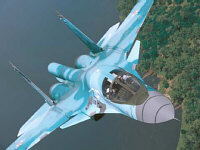
Su-34 Fighter-Bomber
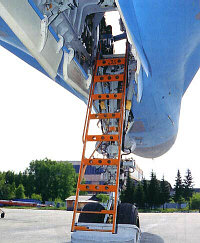
Cockpit access in the front wheel well
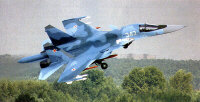
Redesigned nose section and central tailboom
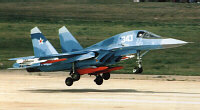
Tandem placed two-wheeled main gear
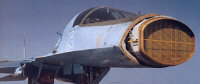
Elliptic shaped phased array nose radar
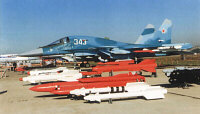
Su-34 multi-role weapons capability
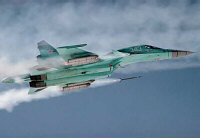
Su-34 firing unguided rockets
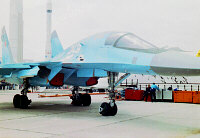
Su-32FN at Le Bourget airshow in 1995
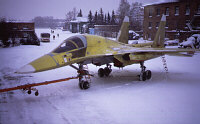
Last prototype Su-34 '47' before painting
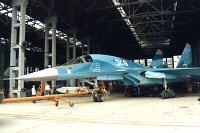
Su-34 (Su-32FN) at the Sukhoi test facility

 Back to Index

