
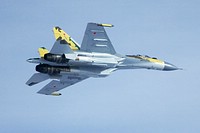
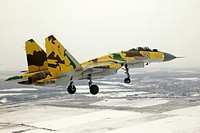
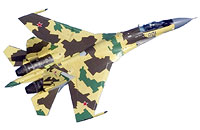
Sukhoi Su-35 "4++ Generation Flanker"
Role: multi-role fighter
Origin: Russia
Design: Sukhoi
Production: KnAAPO
Variants: Su-35 (T-10BM), Su-35S
Operators: Russia (Sukhoi/KnAAPO, Russian Air Force)
New Su-35
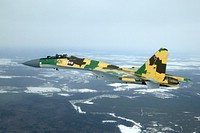
The designation Su-35 had already been used from 1992 onwards to market the company's modernized Su-27M "Super Flanker" (bureau designation T-10M). Developed in the late 1980s for the Soviet Air Force, the Su-27M incorporated a modified aerodynamic configuration, uprated engine, and upgraded avionics. Sukhoi realized by 2002 that it would no longer be able to compete with comtemporary and future foreign fighters. The single-seat Flanker needed to be drastically upgraded, including a major redesign of its airframe. Furthermore, the Sukhoi-owned KnAAPO plant had been struggling to compete with its Su-30MK2 against the more advanced Su-30MKI derivatives of the Irkut Corporation, its rival Flanker producer which is only partially owned by Sukhoi. Sukhoi started development of a new 'intermediate fighter' to fill the gap between its "fourth generation" Su-30MK and its upcoming "fifth generation" fighter in development under the PAK-FA (Perspektivnyi Aviatsionnyi Kompleks Frontovoi Aviatsii - Future Air System for Tactical Aviation) program, Sukhoi developed a new "4++ generation" Su-27 derivative, internally known as T-10BM. The Su-27 Bolshaya Modernizatsiya ('big modernization') utilizes a redesigned airframes based on the standard Su-27 and is fitted with the latest Russian avionics, advanced weapons and new engines. Re-using the Su-35 sans suffix designation, it is primarily aimed at the export market, but Sukhoi also hopes to produce localized versions for the Russian Air Force.
New Airframe
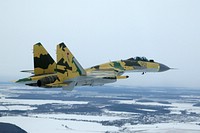
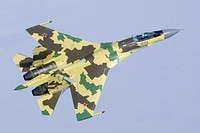
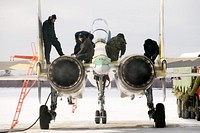
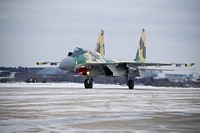
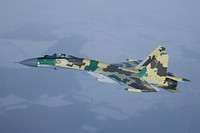
Unlike the Su-27M and Su-30MKI, the new Su-35 features the same aerodynamic configuration as the basic Su-27, but with larger wings and engine intakes. The Su-35 is not fitted with canards. The flight performance and manoeuvrability will instead be improved by the advanced KSU-35 fly-by-wire system. It also lacks the larger vertical tails of the Su-27M. Internal fuel capacity has been increased by redesigning the airframe internal volumes. The Su-35 can carry 11,500kg of fuel, which can be increased to 14,300 kg using two underwing drop tanks. Like previous Su-27 derivatives, it has also been fitted with a retractable refueling probe. The new Su-35 lacks the Su-27's large upper air brake owing to advanced rudder control by the KSU-35 system.
Perhaps the most significant improvement is the extensive use of titanium alloys, which increases the aircraft's service life from 4,000 to 6,000 hours, with the time between overhauls growing to 1,500 hours. Another significant improvement is the use of radar absorbing materials (RAM) in various parts of the airframe reducing the fighter's X-band radar cross section within the +/- 60° sector.
New Engine - Saturn 117S
The Su-35 is powered by the NPO Saturn's izdeliye 117S, the new engine is a much improved derivative of the Su-27's AL-31F turbofan based on the company's earlier AL-41F. In its current form the 117S (designated AL-41F1A) offers 16% more thrust than the standard AL-31F, providing 14,500 kgf in afterburner mode and 8,800 kgf in maximum dry setting. The engine's service life has been increased from 1,500 to 4,000 hours, with time between overhauls increasing from 500 to 1,000 hours. Flight testing started in March 2004 with the 117S fitted to the Su-27M '710' testbed. Two production standard 117S engines now power the first Su-35 prototype. Additional engines are being produced for the next two Su-35 prototypes, while development of even more powerful variants of the engine continues. Production of the 117S is shared between the NPO Saturn plant in Rybinsk and the Ufa Engine Production Association (UMPO) in Ufa.
Irbis phased array radar
The Su-35 new fire control system consists of the N035 Irbis multifunction radar system and the OLS-35 electro-optical search-and-track
system. The N035 Irbis (Irbis-E for export) is an X-band radar with a 900mm passive phased array.
Developed by the Tikhomirov NIIP institute the Irbis radar is a derivative of the N011M Bars radar
with wider search zone, increased detection range, wider range of operating frequencies and improved
resistance to jamming.
The N035's computing system consists of two Russian Solo-35 processors. A new two-stage mechanical
drive mounts the phased array. The passive electronic array scans 60° in azimuth and elevation, while the
mechanical steering enables the array to rotate an additional 60° for a wider search zone. The Irbis-E
is capable of tracking of up to 30 aerial targets in track-while-scan mode and allows simultaneous engagement
of two targets using semi-active radar homing missiles or up to eight targets using active radar homing missiles.
The Irbis-E is advertised to be capable of detecting and tracking a fighter-sized target head-on at 350-400 km range using its long-range detection
mode within a limited sector. It is also claimed to be capable of detecting 'super-low-observable' targets with 0.01 m2 RCS at 90 km range.
For ground attack, the radar is capable of terrain mapping and target acquisition in different resolutions using
Doppler beam sharpening and synthetic aperture focusing modes. In combined ground and air mode, the radar is
capable of tracking aerial threats with sufficient precision to engage with active radar homing missiles.
Future options for the Su-35 might include a rear-facing radar such as the N012 to be fitted in the tailboom, but
the current Su-35 does not contain such equipment.
OLS-35 electro-optical search-and-track system
Developed by the UOMZ (Ural Optical and Mechanical Plant) in Yekaterinburg, the OLS-35 infrared/laser search-and-track (IRST) system provides the second major sensor of the Su-35's fire control system. The OLS-35 combines a scanning infra-red direction finder and thermal imaging module for target detection and identification with a laser rangefinder/designator and TV camera. The OLS-35 offers sigficant improvements over the OLS-27 of previous Su-27 versions, owing to the use of more advanced electronics, algorithms and software. Information regarding detection ranges and detection/tracking zones vary across sources. The estimated range for detection from a tail-on aspect has been reported to be 70-90 km and up to 40-50 km for head-on engagement for non-afterburning targets. The detection and tracking zone is 55-60 ° upwards, 15 ° downwards, and between 60° and 90° in azimuth. The laser is capable to range aerial target up to 20 km and ground targets at 30 km with a precision of five meters. Alternatively, the Su-35 may be fitted with one of the new electro-optical systems developed by NIIPP (Scientific Research Institute of Precision Instruments Engineering) for the MiG-35.
Glass Cockpit
As with all 4th and 5th generation fighter aircraft, the human-machine interface received considerable attention from its designers. The integrated avionics suite is controlled by the central information and control system. The 'open architecture' system's main components are two central digital computers, digital databus and the 'glass cockpit' display system. The latter consists of two 15" (9x12") MFI-35 full-colour multifunction LCD with 1400x1050 pixels, a multifunction control panel with built-in display unit, IKSh-1M wide-angle collimator HUD and control display unit. The Su-35 cockpit retains the conventional central stick and throttle arrangement of the Su-27, but incorporates the HOTAS principle.
Weapons: Longer-range Missiles
Just like previous Su-27 derivatives, the Su-35 is capable of carrying a maximum payload of 8,000 kg on its 12 external hardpoints. The weapons suite has been further expanded with upgraded variants of existing weapons as well as several new long-range missiles.
The Su-35's air-to-air suite will comprise advanced R-27 versions (R-27ET1, R-27ER1, R-27EP1) and the active R-77 and new R-77M for medium range missiles, the R-73 and new R-74M short range missiles. Up to 12 R-77/R-77M can be carried, with two pairs placed between the nacelles. The Su-35 will also be able to equip up to five long-range missiles. Dubbed 'very-long-range' air-to-air missile, the K-100-1 (izdeliye 172S, 172S-1) has been developed by Novator in Yekaterinburg from its earlier K-172, which was first developed in 1991 for the Su-27M. The missile has a range of 300-400km and is capable of reaching speeds up to 4,000km/h pulling up to 9Gs to attack targets flying at altitudes ranging from 3m to 30,000m.
Air-to-surface missiles include up to six Kh-29T/L AGM, Kh-31A AShM, Kh-31P ARM, or up to five Kh-59MK longe-range AShM, Kh-58UShE extended range ARM, or up to three Kalibr-A long-range AShM, or one Yakhont heavy long-range AShM. Other air-to-surface weapons include a wide selection of guided bombs as well as unguided bombs and rockets. Laser-guided rockets are also planned to be added to the Su-35's arsenal.
Su-35 Program Status and Schedule
Sukhoi's 'intermediate fighter program' has already seen several delays. Sukhoi originally planned
to start series production of the new type in 2007. The deadline was then changed to 2009 and the second prototype
was scheduled to be ready in mid-2007 and to be fitted with the Irbis-E in August 2007. However by August 2007,
Sukhoi and KnAAPO were barely able to unveil the first Su-35 prototype in the static show at the MAKS 2007 air
show. On February 19, 2008, the first prototype Su-35-1 '901' finally made its maiden flight and Sukhoi issued
a press release reporting 2010-2011 for the start of series production.
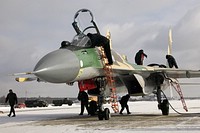
The second prototype Su-35 '902' made its maiden flight on 2 October 2008, flown by Sergey Bogdan from the KnAAPO factory's Dzemgi airfield at Komsomol'sk-na-Amur.
KnAAPO announced on March 23, 2009, that the first two prototypes had completed 100 flights, finalizing testing of the flight control system.
The third prototype built is solely used for ground testing. The fourth aircraft built would be the third flying prototype, but it
was destroyed on April 26, 2009, prior to its scheduled first flight the next day. The aircraft ran
off the runway at Komsomol'sk-na-Amur during high-speed taxi tests, hitting an obstacle causing a destructive fire.
Test pilot Eugene Frolov was able to eject and escape unhurt.
The Su-35-1 '901' prototype did not feature the full mission systems suite.
The second and third prototypes were planned to receive full mission equipment, with '902'
devoted to mission systems and integration testing. Following the incident with the third flying prototype, KnAAPO stated
the development programme should not be affected by the loss due to the success with the first two aircraft.
As the original Russian procurement budget for 2007-2015 did not provide funding for the acquisition of new fighter aircraft, Sukhoi originally envisaged the Su-35 mainly for export customers. Only provisions had been made for PAK-FA development and the Su-27SM upgrade program of the existing fleet of Su-27s. Having been introduced to the new Su-35 and also MiG-35 at MAKS 2007, premier Putin suggested a revision of the defence procurement budget to include these new aircraft. After the five-day war with Georgia during the summer of 2008, the Russian Air Force need for modernization became even more apparent. Due to delays in the PAK-FA development programme, the Russian Air Force wanted to buy Su-35s as interim fighter. With the global economic crisis the Russian government also decided to boast the Russian economy by investing in the defence sector. For Sukhoi this materialized in a $80 billion Rubles ($2.5 billion USD) contract for 12 Su-27SM3, four Su-30M2, and 48 new-built Su-35s, signed on August 18, 2009. All 48 Su-35 are to be delivered by 2015.
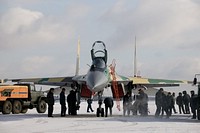
Sukhoi announced on November 17, 2009, that KnAAPO had begun component production for the initial production batch. Assembly of the first production standard aircraft for the Russian Air Force started in 2010. The domestic version is designated Su-35S and differs from export versions by having local IFF, electronic warfare and communication systems. The Irbis radar is also likely to have additional operating modes compared to its export version. In August 2012 state acceptance testing began at the Russian Air Force 1338th Flight Test Centre, Chkalovskaya airbase, of the 929th GLITs named after Valeriy P. Chkalov in the Astrakhan' Region. By this time Sukhoi also announced the Su-35 program had completed over 650 test flights. The first batch of six production Su-35S were handed over to the Russian Ministry of Defense on December 28, 2012, at KnAAPO.
Market Analysis: Su-35 Export Potential
Sukhoi/KnAAPO primarily regarded the Su-35 as an export product. Sukhoi initially estimated to be able to produce at least 300 Su-35 fighters, the most recent estimate envisages gaining export orders for at least 160 Su-35s. Potential customers include Algeria, India, Malaysia and used to include Brazil. Because the Su-35 solely relies on Russian equipment, various other countries that are subject to (potential) US and/or European embargo could also be seen as potential customers, such as Venezuela, Syria and Libya (prior to the recent political developments in the latter two). Contrary to countries on friendly terms with the West, the Su-35 should be able to easily compete for orders from such countries as almost all rivals contain US or European technology. Even the Irkut-built Su-30MKI features French, Israeli and Indian equipment, although the rival Flanker producing company already shown to be able to integrate alternative solutions as evidenced by the Su-30MKM and Su-30MKA.
Although China was reported to have threathened to offer the J-11B/BS Chinese-developed Flanker copies for export not too long ago, more recent reports suggest the relationship between the two countries has improved and further military cooperation with China is envisaged. With China as a customer for the Su-35, the envisaged 300 aircraft might become reality. Rosoboronexport declared that it has offered China to sell an initial batch and then organize license production in China. Russia is also offering the Su-34 tactical bomber and Su-33 naval fighter. Apart from Russia, no other country is offering such advanced aircraft to China, on the other hand China's aircraft industry has made significant progress when it comes to developing its own designs and technology. Ultimately China's interest in the Su-35 may be limited to a small batch and its avionics to further enhance its Flanker-based J-11B/BS derivatives, as we've seen with interest in the Su-33 resulting in the J-15 copy rather than an order.
But perhaps even more promising as a prospected buyer for the new Su-35 is Venezuela. Venezuela has expressed interest in the Su-35 to supplement its fleet of 24 Su-30MK2 delivered in 2006-2008, enabling the AMV to fill the gap left by the retirement its ageing Mirage 50 fleet and limited availability of its remaining F-16s. Unless Venezuela decides to part with KnAAPO and invest in the development of a 'pure' Russian Su-30MKI derivative, the Su-35 will easily prove superior to Venezuela's only alternative: additional Su-30MK2 two-seaters or MiG-35.
Algeria recently acquired the multi-role Su-30MKA to replace its ageing fighterbombers. The ageing MiG-29 fighters were to be replaced by MiG-29SMT/UBT. As the order was cancelled due to quality problems, the country is now investigating options for a new fighter. The Su-35 is set to become one of the options, other candidates are believed to become the Boeing F/A-18E/F Super Hornet, Saab Gripen NG, and Dassault's Rafale. Algeria has also been criticizing the Israeli components in the Su-30MKA, which is understood to rule out additional Su-30MKA orders.
Delays in the PAK-FA fifth generation fighter development also means India will potentially be faced with a fighter gap, as India partnered with Russia for its fifth generation fighter. With the M-MRCA program already underway for which India selected the Dassault Rafale and additional HAL-built Su-30MKI fighterbombers on the way, it remains to be seen if India wishes for additional single-seat fighter aircraft.
Malaysia will retire its fleet of MiG-29Ns in 2010 and is expected to enter the market for a single-seat air defence fighter to replace it. KnAAPO's Su-35 will compete against IAPO's Su-30MK variants as Rosoboronexport is expected to offer both, in addition to Saab's Gripen NG. Already operating 18 Su-30MKMs, Malaysia may settle for more Su-30MKMs in favor of the Su-35 or go for more Boeing F/A-18E/F Super Hornets in addition to F/A-18D Hornet replacements.
Brazil had included the Su-35 (Su-27M) in its 2001 F-X program to select a future fighter for its air force. Postponed before completion and subsequently cancelled in early 2005, Brazil relaunched its tender for 36 new fighters in 2008, dubbed F-X2. Total requirement has been stated to be 120 aircraft to be delivered from 2014 onwards. Although considered in the first round of the selection process based on RFI comparisons, the Su-35 did not make it to the second round. This represents the first lost opportunity for the new Su-35. Brazil will make its final decision between Dassault's Rafale, Saab's Gripen NG and Boeing's Super Hornet Block II in the near future.
Syria has been looking at new Russian weapons recently, including the Su-30MK2 and even the possibility of acquiring new-built MiG-31 air defense fighters. Moscow's recent arms export policy with regards to the Middle East only allows 'defensive' weapons to be supplied to Syria. Additionally MiG-29 upgrades seem to be higher on the Syrian agenda. Thus a potential order for new multi-role Su-35s still seems far away, especially in regards of the civil war Syria entered. Syria is also believed to be limited in funds, making the MiG-29M2/MiG35 and Su-30MK2 more likely candidates when the situation stabilizes.
Having restored its political ties with France Libya had expressed interest in purchasing a limited number of Rafales. Also the US aerospace industry is likely to enter the market with the expiring of the US embargo, whether this will lead to any US fighters being offered for sale remains to be seen. The country can certainly be considered as a potential buyer as the Su-35 is believed to be much cheaper than its Western rivals. However Libya requires a comparatively limited number of aircraft, plus the country's new regime is understood to have better relations with Paris and London than Moscow.
If the new Su-35 market unfolds like that of the Su-30MK multi-role Flankers, more potential customers are likely to emerge soon. But at this time, the potential market size for heavy Russian jets seems to be rather limited, with even the most likely buyers having multiple options and fifth generation fighters on the horizon.
Future Su-35 based variants
The Su-35 is the final version developed from Su-27 as Sukhoi's efforts as well as State funding increasingly goes towards the fifth generation T-50 fighter, unmanned platforms and other types of aircraft. However the Su-35 may see several subvariants, at least by the time the Su-35 has matured and needs improvements to remain competitive on the export market.
There was some speculation that a proposal for a new-built ship-borne Su-33 variant will emerge based on the Su-35 to equip future carriers of the Russian Navy. However, more recently it was announced the Russian Navy will re-equip with new MiG-29K shipborne fighters and even the idea of early retirement for the existing Su-33 fleet was floated. It seems unlikely that Flankers have any future at all with the Russian Navy.
Between the Su-27M, the Su-35 of the 1990s, and today's Su-35, Sukhoi/KnAAPO had developed the Su-35UB two-seat combat capable trainer for the export market. It remains to be seen if there will be a similar two-seat variant based on the new Su-35. Another possibility is that Sukhoi/KnAAPO will further upgrade its Su-27UBK or Su-30MK offering for enhanced commonality with the Su-35 single-seater.
[Editor: the latest Su-35 product (T-10BM) is often referred to as Su-35BM on the internet, assumingly to avoid confusion
with the earlier Su-35 on offer in the 1990s (the T-10M/Su-27M for export). To my understanding the Su-35BM designation would technically be incorrect, as it is a big modernization of the Su-27
having little in the common with the Su-27M other than some testbed aircraft, but the name is likely to "stick" for some time until we see more new official designations along the lines of Su-35S]
-
Sources:
- AFM (2008). Second Su-35 Flown, Air Forces Monthly #249 December 2008, p.24, Key Publishing Ltd, UK.
- AFM (2009). Third Su-35 Destroyed Just Before First Flight, Air Forces Monthly #255 June 2009, p.22, Key Publishing Ltd, UK.
- AFM (2009). Russian AF Orders 48 New Fighters, Air Forces Monthly #259 October 2009, p.26, Key Publishing Ltd, UK.
- AFM (2010). KnAAPO Begins Su-35 Production for Russian AF, Air Forces Monthly, #264 March 2010, p.28, Key Publishing, UK.
- Butowski, Piotr (2007). Wraps come off new Russian fighters, Interavia, Autumn 2007, 689, pp. 34-36.
- Butowski, Piotr (2008). Sukhoi's Latest 'Flanker', Combat Aircraft, European Edition, Vol.9, No.3, pp. 52-55, Ian Allan Publishing Ltd, UK.
- Butowski, Piotr (2009). MAKS 2009, Air Forces Monthly, #260 November 2009, pp.26-27, Key Publishing, UK.
- Fomin, Andrei (2007). Su-35 - a step away from the fifth generation, Take-off, June 2007, pp. 46-53, Aeromedia Ltd, Moscow. Retrieved from www.sukhoi.org on March 27, 2008.
- Fomin, Andrei (2007). Sukhoi's Su-35 Makes Its Debut, Air Forces Monthly #236, November 2007, p. 20, Key Publishing Ltd, UK.
- Hoyle, Craig (2008). Brazil restarts multirole combat aircraft contest, Flight International, 15-21 July 2008, Vol.173, No.5143, p. 10.
- Interfax-AVN (8 Jul 2008). Russia's Sukhoi to build four Su-35 fighters for first phase of tests, Interfax-AVN, Moscow.
- ITAR-TASS (14 Jul 2008). Russia's Sukhoi chief says building fifth-generation jet will take 7-10 years, ITAR-TASS, Moscow.
- Karnozov, Vladimir (2007). Sukhoi gears up for debut flight of multirole Su-35-1, Flight International, 4-10 September 2007, Vol.173, No.5103, p. 22.
- Karnozov, Vladimir (2008-2). Inaugural fight for Sukhoi Su-35-1, Flight International, 26 February - 3 March 2008, Vol.173, No.5127, p. 12.
- Karnozov, Vladimir (2008-7). Russian air force seeks approval for 'worthwhile order' of Su-35 fighters, Flight International, 15-21 July 2008, Vol.174, No.5147, p. 34.
- Sukhoi Company (9 Jul 2008). The end of the first stage the Su-35 test, press release 09 July 2008, Sukhoi Company press service, Moscow. Retrieved from www.sukhoi.org.
- Sukhoi Company (28 Dec 2012). Sukhoi delivered 6 Su-35S fighters to the Ministry of Defense, press release 28 December 2012, Sukhoi Company press service, Moscow. Retrieved from www.sukhoi.org.
- Sukhoi KnAAPO (2007). Su-35 - multirole super-maneuverable fighter, sales brochure, Sukhoi Company. Retrieved from www.knaapo.ru on August 25, 2008.


 Back to Index

