
Sukhoi Su-33 "Navy Flanker"
Role: ship-borne air superiority fighter
Builder: Sukhoi, KnAAPO
Variants: Su-33 (Su-27K), Su-33UB (Su-27KUB), Su-33M (Su-27MK), Su-33MK
Operators: Russia, (China)
In 1985 the first conceptual design for a navalized version of the Su-27 fighter was approved to provide the navy's new carriers with an air superiority fighter for air defense. The carrier-borne aircraft was designated Su-27K (K = Korabelny, Ship-Borne) , factory designation T-10K and was later given the Su-33 designation by Sukhoi. Unlike the Russian Air Force which was reluctant to adopt the OKB's designations for advanced Flanker derivatives, the Russian Navy officially adopted the Su-33 designation for its ship-borne Su-27Ks. NATO/ASCC reporting name for the navalized Su-27 was 'Flanker-D'.
Changes from the basic Su-27
Changes from the shore-based Su-27 were the addition of canards, re-profiled leading-edge root extensions, redesigned folding outer wing panels, seperately controlled aileron and flaps. These changes were supported by an upgraded fly-by-wire control system and hydraulic system.
The Su-27K airframe and landing gear was strengthened to cope with the additional stress from carrier landings. The nose gear was changed to a twin-wheeled one with a telescopic strut and features an additional landing light and three-colour indicator lights for the carrier's flight controller's reference regarding glide-patch and landing speed.
The aircraft was equipped with a retractable hook system. The AL-31F engines were uprated to enable the pilot to recover from a failed hook up.The drag chute was removed from the tail boom. The boom itself was shortened and flattened. The wings, the horizontal stabilisers as well as the nosecone were made to fold up to reduce the aircraft's dimensions. Other visible changes included the addition of two hardpoints and a retractable in-flight refuelling probe on the port side forward of the cockpit. The IRST sensor was shifted to the starboard side.
The fighter's navigation, landing and fire control systems were all upgraded for the new environment. The SUV-27K fire control system enables the fighter to intercept aerial targets with the support of the aircraft carrier's command and control.
The 24 series produced Su-27Ks were deployed with the Northern Fleet and were assigned to the Admiral Kuznetsov aircraft carrier, which deployed on her first long-term ocean cruise in 1995 with 13 Su-27K naval fighters onboard.
Su-27KUB Trainer
To train Su-27K pilots the Su-27KUB (Su-33UB) was developed. The Su-27KUB is a combat capable trainer which features a side-by-side cockpit similar to the Su-27IB (Su-32/34) bomber. This layout was needed because the Su-27UB tandem cockpit gave not sufficient visibility for the instructor to make a safe carrier landing.
The Su-27KUB has a larger wing area, canards, ventral fins, rudders and horizontal stabilisers. These changes enable lower approach speeds and a smoother and thus safer landing. The nose section has considerably been modified to fit the side-by-side cockpit, but retains the circular nose (unlike the Su-27IB). The pilots enter the cockpit via the nosewheel bay. The IRST is, unlike on the Su-27K, centered in front of the cockpit and the IFR probe is placed on the port side just below the canopy. The gear, air intakes, fins, hook, etcetera remained the same as on the Su-27K. The maiden flight, first carrier landing and take off all took place in 1999. In the following years, the Su-33UB has succesfully completed testing and certification, which enables the type to enter series production.
Upgrading the Su-33
The Su-27KM (Su-33M) is a proposed upgrade of the Su-27K. In the past the proposed upgrade was based on the Su-27M, but is now thought to evolve into a more advanced upgrade based on the air force's Su-27SM2 and the latest Su-35 (Su-27BM) export derivative. With upgraded fire control system the fighter is able to deploy the latest RVV-AE (R-77) air-to-air missile and guided air-to-surface weapons, including laser and TV guided missiles and the Moskit heavy anti-ship missile. Other features include updated navigation, communication, ECM and cockpit with LCD screens and modern HUD. There were also plans for a modernised export version of the Su-33 designated Su-33MK, which could be revived now China has shown interest.
Future
Until recently the Su-33 future seemed to be limited to the Russian Navy's fleet of 24 Su-33s operating from its sole aircraft carrier Kuznetsov. Although it plans to have two new aircraft carriers by 2017, at the same time it was revealed a new multi-purpose fighter would be developed to equip them.
However in late 2006 it was revealed by Russian newspaper Kommersant that
Russian State arms export agency Rosoboronexport
had entered negotiations with China for the sale for up to 50 Su-33 naval fighters in a deal worth up to
$2.5 billion. An initial fleet of 12 aircraft would be operated from the former Soviet aircraft carrier
Varyag, which China acquired from the Ukraine in 1999 and is currently being refitted at the Dalian
shipyard. The deal was expected to include an initial $100 million order for two KnAAPO produced aircraft
for trials. Additionally China sought to procure 12 aircraft to equip its first carrier.
However in March 2009, the Moskovsky Komsomolets newspaper reported that negotiations on the deal had collapsed
recently over fears that Beijing could produce cheaper export versions of the aircraft with Chinese avionics
and systems, in similar fashion to the J-11B. Additionally Russia was reportedly seeking to secure an order
for at least 24 aircraft to recoup production costs.
Despite this latest report, China is unlikely to be able to fulfill its requirement for a carrier capable fighter
in the near future, even though more expensive Western alternatives are theoretically available. In addition to
the Varyag, China plans to deploy a fleet of three indigenously developed carriers in 2016. Although Chinese
plans include the development of its own naval fighter to equip them, it will take some time to develop it as it
currently owns no other carrier capable fighters. In this light it is possible that negotiations for the Su-33
will be resumed at a latter stage, if China abandons its plans to export the J-11B.
-
Sources:
- AFM (2006-2008). Air Forces Monthly, Key Publishing, UK.
- Fomin, Andrei (2000). Su-27 Flanker Story, RA Intervestnik, Moscow, Russia.
- RIA Novosti (10/03/2009), Russian-Chinese Su-33 fighter deal collapses - paper, http://en.rian.ru, Moscow, 10 March 2009.

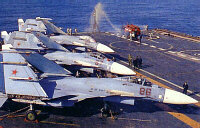
Su-33 (Su-27K) carrier-borne Flanker
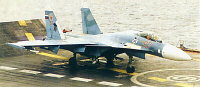
Su-33 taking of from the Admiral Kuznetsov
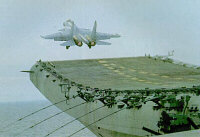
Russia uses the jump-ramp instead of catapults
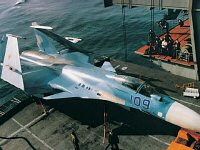
Su-33 with wings folded on the decklift
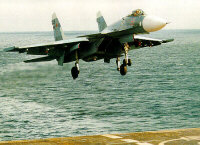
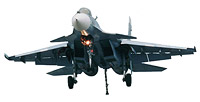
Su-33 with extended hook on final
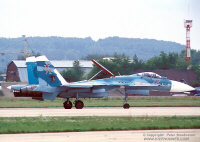
Su-33 display at the Zhukovsky airshow
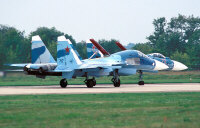
Su-33UB (Su-27KUB) together with Su-33
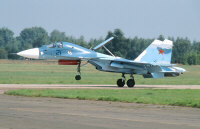
Su-33UB landing with airbrake deployed

 Back to Index

