
Su-27 Flanker Operators List
|
1. Russia (USSR) 2. Algeria 3. Angola 4. Belarus 5. China 6. Eritrea |
7. Ethiopia 8. India 9. Indonesia 10. Kazakhstan 11. Malaysia |
12. Uganda 13. Ukraine 14. Uzbekistan 15. Venezuela 16. Vietnam |
Info on other countries: a. Iran prospective buyer b. c. d. |
| 1. Russia (and formerly USSR): BACK TO TOP | ||||||||||
| Delivered: | ~500x Su-27S/P/SM/SM2/SM3/Su-27UB ~5x Su-27PU/Su-30, 20x Su-30M2 24x Su-27K(Su-33), 1x Su-33UB ~3x Su-27M ~75x Su-34 48x Su-35S 44x Su-30SM | 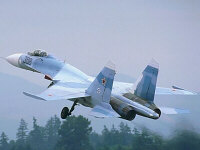 | ||||||||
| Service: | ~70x Su-27S/P/Su-27UB, ~65x Su-27SM/SM2/SM3 ? x Su-27PU/Su-30, 20x Su-30M2 ~24x Su-33 ~70x Su-34 48x Su-35S 44x Su-30SM | |||||||||
| On order: | 54x Su-34 (out of 92), 48-50x Su-35S, 36x Su-27SM3, 28x Su-30SM + 48 planned | |||||||||
| First delivered: | 1985 (Su-27) ? (Su-30) April 1993 (Su-27K) 1996 (Su-27M), 15 Dec 2006 (Su-34) 2011 (Su-30M2) 2013 (Su-35S) 2013 (Su-30SM) Jul 2014 (Navy Su-30SM) | |||||||||
| Last delivered: | ? (Su-27) ? (Su-30) ? (Su-33) ~2020 (Su-34) ~2015 (Su-35S) ~2020 (Su-27SM3) ~2020 (Su-30SM) | |||||||||
| RuAF Units 2015: |
Centrally Subordinated 968th IISAP, Lipetsk, various aircraft of all variants 237th TsPAT Russian Knights, Kubinka, Su-27/UB 6th Air and Air Defence Army, Western Military District 159th GvIAP, Besovets (Petrozavodsk), Su-27P/UB (Su-35S) 790th IAP, Khotilovo, Su-27P/UB 47th GvSAP, Baltimor (Voronezh), Su-34 14th Air and Air Defence Army, Central Military District - 11th Air and Air Defence Army, Eastern Military District 23rd IAP, Dzemgi (Komsomolsk-on-Amur), Su-35S, Su-27SM/UB, Su-30M2 (formerly Su-27S) 22nd GvIAP, Tsentralnaya Uglovaya (Vladivostok), Su-27SM/UB, Su-30M2 120th GvSAP, Domna (Chita), Su-30SM 4th Air and Air Defence Army, Southern Military District 3rd GvSAP, Krymsk, Su-27SM3/UB, Su-30M2 959th BAP, Morozovsk, Su-34 27th Composite Aviation Division, Crimea 37/38th IAP, Belbek (Sevastopol), Su-27/SM/UB, Su-30M2 | |||||||||
| RuN Units 2015: |
Northern Fleet, Kola Peninsula 279th KIAP, Severomorsk-3 (Murmansk), Su-33 Black Sea Fleet, Sevastopol 43rd OMShAP, Saki (Crimea), Su-30SM | |||||||||
| Information: |
Deliveries of the Su-27 fighters to the Soviet Air Force (VVS) and Air Defence Forces (PVO) started in 1985.
Most of the series produced aircraft were T-10S design, hence the designation of Su-27S. Since
1989 all new manufactured aircraft had their air-to-ground weapons capability removed, carrying
the factory designation T-10P indicating the pure air defence fighter to be intended mostly for the PVO units, thus making the "semi-official" designation Su-27P.
The first batch of 20 Su-27s were handed over from 22 June 1985 to the ADF (PVO) fighter regiment based at Dzemgi AB in the Far East. From 1986 the re-equipment of fighter units was accelerated. By 1990, the European part of the Soviet Union had received 367 Su-27 fighters (138 for the Air Force and 229 for the ADF fighter regiments). 67 of the Soviet Air Force aircraft were stationed in Poland. It was then estimated by Western experts that the total number of Su-27s in existence was 500. After the breakup of the Soviet Union about one hundred aircraft found new owners. The aircraft in Poland were retreated in the summer of 1992. By early 1996 it was estimated that 130 Su-27 fighters were in service with the Air Force and 300 with the ADF. In addition, the Northern fleet operated 24 Su-33 (Su-27K) naval fighters. In late 1998, the Air Force and Air Defence Force were unified in the Russian Air Force. Press reported in early 2000 that the Russian Air Force (RuAF) operated about 340 Su-27 aircraft, equipping 12 fighter regiments and training centers of Lipetsk, Savasleika, the academy at Kushchovskaya as well as the Kubinka Aircraft Demonstration Center (Russian Knights). During these years, advanced Flanker variants were developed with prototypes flown by Sukhoi Design Bureau, KnAAPO and the Gromov LII Flight Research Institute. Focus shifted to export variants and production as Russia did not have the funds to procure new aircraft. Protracted state trails did not lead to any firm production plans. By this time, the RuAF had received five Su-30 basic variants and three Su-27M (also known as Su-35 at the time) delivered. The Su-30s were operated by the two Centres of Combat Employment and Flight Personnel Retraining: Savasleika (tail numbers 50, 51, 52, 53) and Lipetsk (tail numbers include 66). Test Pilots team was also equipped with one Su-30 (tail 597). The three Su-27Ms were deployed with the RuAF's Flight Testing Centre at Akhtubinsk in 1996 (tail numbers 86, 87, 88). Between 2003 and 2009, 55 Flankers were upgraded to Su-27SM. In mid 2006, the 23rd IAP had become the first Russian Air Force regiment to fully re-equip with a full complement of 24 Su-27SM upgraded Flankers. On August 18, 2009, a $80 billion Rubles ($2.5 billion USD) contract was signed for 12 Su-27SM3, four Su-30M2, and 48 new Su-35S to equip the Russian Air Force. The four Su-30M2s are KnAAPO built Su-30MK2 that were originally destined for the PLAAF, but not delivered. The 12 Su-27SM3 upgraded Flankers were believed to ompletely remanufactured from surplus or reserve Su-27 airframes, although some sources call these newly built. In any case, they were taken on strength in 2011. In December 2012, 16 more Su-30M2 were ordered and taken on strength in 2013-2015. Around 70 Su-27P/Su-27UB were remaining in service by 2015. In mid-2015 a contract was signed to upgrade 36 Su-27Ps to the Su-27SM3 standard. Meanwhile the Su-30SM from Irkut was ordered for both the Russian Air Force (60) and Russian Navy (12), with plans for 48 more to join the Russian Naval Aviation shorebased units. The remaining Su-33s are currently flying from land as well, with the MiG-29K/KUB being ordered as Russia's future carrier-borne fighter replacing the Su-33. The first Su-35S was handed over for testing and evaluation in 2011, followed by additional aircraft in 2012. The 23rd IAP became the first Su-35S-equipped unit receiving its initial eight Su-35S in February 2014, eventually receiving 24 aircraft to equip two squadrons. Meanwhile the type official entry into service as combat-capable air system was delayed as joint state trails revealed shortcomings and deficiencies leaving to modifications by the manufacturer. Nevertheless the contract for delivery of 48 Su-35S was to be completed in 2015. The 22nd Guards IAP and 159th IAP will each also receive a Su-35S squadron. A follow-on contract for another 48 Su-35S is planned, with production to average 12 aircraft per year for 2016-2019. Up to 2020 the Russian Air Force will procure a large number of improved Su-34 bombers, to replace the Su-24 'Fencer' fleet in primarily the strike attack role. On December 15, 2006, the first two Su-34s were officially handed over to the Russian Air Force. The aircraft 'Red 01' and 'Red 02' (the 8th and 9th aircraft produced) were delivered to the 4th Combat and Conversion Training Centre in Lipetsk for final stages of state trials. They were joined on August 3, 2007, by the first production standard Su-34. This first production standard Su-34 were rushed into combat during the five-day war with Georgia in August 2008, even though the type had not been commissioned into service yet. In December 2008, a contract was signed for the production of 32 Su-34s. By 2010 24 Su-34s were expected to be delivered for the first air regiment at Voronezh, but the production at NAPO was delayed reportedly due to the company having difficulty with re-equipping the factory and recruitment of workers with the required technical skills. Meanwhile an affordable capability upgrade for the Su-24M has filled the gap. The first batch of six Su-34s first entered operational service in early 2012 and the Russian MOD finally committed to the production up to 2020 of 92 more Su-34s. The 2008 order for 32 aircraft was completed by the end of 2013. In March 2014, the Su-34 was finally commissioned into service as fully combat-capable. As of 2015, five pre-production and early production aircraft remained with Lipetsk training centre and the 929th GLIT test centre, the 47th SAP had 24 Su-34s equipping two squadrons and the 559th BAP had received 36 aircraft equipping three squadrons. Further deliveries in 2015 would see the start of re-equipment of the 277th BAP. | |||||||||
| others in alphabetical order | ||||||||||
| 2. Algeria: BACK TO TOP | ||||||||||
| Delivered: | 44x Su-30MKA |  | ||||||||
| Service: | ~44x Su-30MKA | |||||||||
| On order: | 14x Su-30MKA | |||||||||
| First delivery: | Jan 2008 (Su-30MKA) | |||||||||
| Last delivery: | late 2017 | |||||||||
| Units: | Ain Beide | |||||||||
| Information: |
Rumours of Algeria operating Su-30MKs had been going
on for some years after Sukhoi/KnAAPO presented a Su-30MKK to Algeria for evaluation, the aircraft had Algerian
markings applied for the event. On the internet 'photoshopped' Chinese Su-30MKK images started to emerge with Algerian
markings pasted over the Chinese ones. However it was not until January 2006 that a Flanker deal was finalized. Algeria placed an order for 28 Su-30MKA. Build by Irkut the Su-30MKA is based on the Su-30MKI/Su-30MKM design, not the KnAAPO produced Su-30MKK. Like the Su-30MKM the Israeli supplied avionics of the Su-30MKI will probably be replaced with Russian and French alternatives. Although it has been reported it is closer to the Indian Su-30MKI standard, than the Su-30MKM. Trials are currently carried out integrating the Thales Damocles LDP/TGP on the Su-30MKA, as was done on the Su-30MKM. Irkut Aviation Production Association revealed in July 2007 that the first two aircraft had been completed and handed over to the Sukhoi design bureau for flight-testing. The first two Su-30MKAs departed from Irkutsk on December 25, 2007, on board an An-124. After arrival in Algeria, the aircraft were reassembled by Russian technicians. Russian pilots tested the aircraft after the New Year holidays, before they were formally handed over to Algeria in 2008. By August 2009, 22 Su-30MKAs were delivered with the remaining six aircraft to follow that year. Another batch of 16 aircraft was ordered and by 2015 Algeria had 44 Su-30MKA in service. In September 2015 it was revealed Algeria signed another deal in April 2016 for 14 additional Su-30MKAs from Irkut to be delivered in 2016-2017. Since November 2015 Algeria is negotiating an initial batch of 12 Su-34 fighter-bombers manufactured by NAPO. | |||||||||
| 3. Angola: BACK TO TOP | ||||||||||
| Delivered: | |  | ||||||||
| Service: | ~1x Su-27/Su-27UB | |||||||||
| On order: | 12x Su-30K | |||||||||
| First delivered: | mid 2000 (2014/2015 for Su-30K?) | |||||||||
| Last delivered: | ? | |||||||||
| Units: | Ain Beide | |||||||||
| Information: |
Angola ordered eight Su-27 Flankers from Russia in 2000, consisting of Su-27S single-seat and at least one Su-27UB twin-seat
to equip the Força Aérea Nacional de Angola (FANA).
Some sources suggest that the aircraft would come from Belarus. Reportedly only a single Su-27S and the Su-27UB were actually delivered.
One was lost on 19 November 2000, claimed to have shot down by SA-14 MANPADs.
Angola reportedly purchased 12 restored Su-30K from the surplus Su-30Ks that were stored in Belarus following the contract with India to swap the interim 18 Su-30K aircraft for new Su-30MKIs rather than having them upgraded as initially envisaged. It's unknown whether the jets for Angola will receive any additional work than the required post-storage overhaul. | |||||||||
| 4. Belarus: BACK TO TOP | ||||||||||
| Delivered: | 23x Su-27P/Su-27UB | 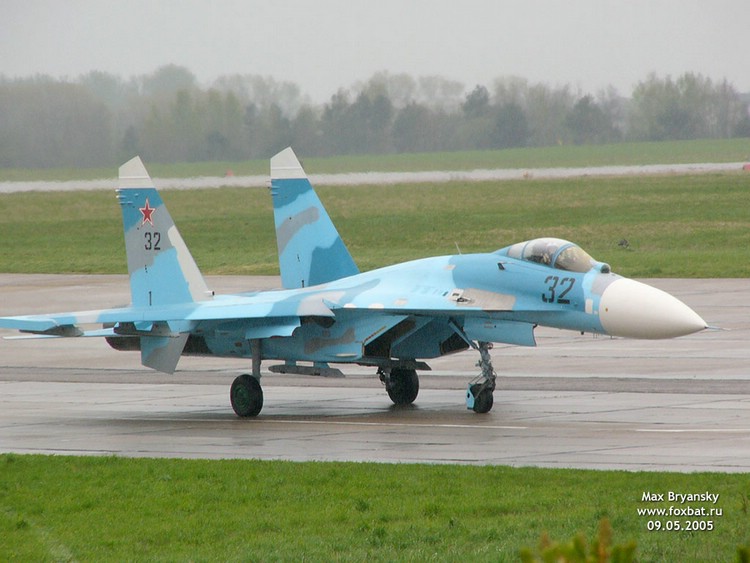 | ||||||||
| Service: | < 21x Su-27P/Su-27UB/UBM1 | |||||||||
| On order: | - | |||||||||
| First delivered: | 1992* | |||||||||
| Last delivered: | 1992* | |||||||||
| Units: | 61st IAB Baranovichi | |||||||||
| Information: |
Belarus inherited a lot of combat aircraft after the break up
of the Soviet Union, among them were 23 Su-27 fighters. Belarusian
Su-27 still have the Soviet-era red star on their vertical tails
and no national insignia. The fleet is operated alongside the MiG-29s
at the 61st Fighter Air Base (IAB) at Baranovichi. One aircraft was lost in an accident
in 1996.
After the Belarusian Air and Air Defence Force upgraded its MiG-29 fleet, a decision for a first phase upgrade of its Su-27 fleet was made with plans for a second phase. The planned upgrade included precision guided weapons capability as well as RVV-AE capability and other upgraded avionics. Two Su-27UBs have been recently upgraded to Su-27UBM1 standard, which has been developed by the 558th Aircraft Repair Plant at Baranovichi in cooperation with the Russian Avionics design bureau. A second phase was planned, some of the equipment (jamming pods) having been tested. During the Radom Airshow in Poland in 2009, one Su-27UBM1 was lost in a fatal crash. Belarus Air Force and Air Defence Forces commander, chief of aviation RB Major General Mikhail Levitskiy announced that the purchase of new multi-role Su-30 fighters is considered to replace the existing Su-27s. During 2011, all 18 former Indian Air Force Su-30K returned to Russia were shipped to the 558th Aircraft Repair Plant at Baranovichi. It was thought to be likely that the ex-IAF Su-30K fighters would be sold to Belarus after overhaul and upgrade by the 558th Aircraft Repair Plant. The Su-27UBM1 upgrade is very similar to the Su-30KN multi-role fighter developed by Irkut in 1999, which is an upgraded Su-30K. However, reportedly the deal was abandoned following a dispute between Belarus and Russia over the supply of Russian natural gas. In September 2012, it was reported Russia again offered the jets to Belarus. However recent reports also suggest that Belarus is likely to retire the Flankers from service and no longer interested in the second-hand jets. The 18 ex-IAF Su-30K aircraft remained at Baranovichi (Jul 2012) while Russia offered them to prospective buyers in Africa. According to Russian media, the aircraft were primarily shipped to Belarus to avoid import taxes. From December 2013, the Russian Air Force deployed a detachment of four Flankers from the 159th IAP to Baranovichi for QRA duty, which paved the way for the Joint Regional Air Defence System of Russia and Belarus. It's set to be expanded in 2016 with a permament deployment of a full squadron with 12 Su-27 and 2 Su-27UB Flankers based at Bobruysk airfield in Belarus, which will also provide a QRA detachment at Baranovichi. In May 2016, Belarusian Defense Minister Andrei Ravkov told reporters that Minsk is interested in purchasing the Su-30SM. | |||||||||
| 5. China: BACK TO TOP | ||||||||||
| Delivered: | 36x Su-27SK, 40x Su-27UBK, ~48x J-11, 76x Su-30MKK, 24 Su-30MKK2 | 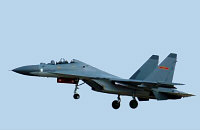 | ||||||||
| PLAAF Service: | ~36x Su-27SK, ~40x Su-27UBK, >20x J-11, ~76x Su-30MKK | |||||||||
| PLANAF Service: | ~23x Su-30MKK2, ~24x J-11BH/SH | |||||||||
| On order: | 2+48x Su-33 ? J-11B, ? J-15 | |||||||||
| First delivered: | Su-27SK/UBK June 1992, J-11 ? 1999, Su-30MKK ? 2002, Su-30MKK2 February 2004 | |||||||||
| Last delivered: | August 2004 (Russia) | |||||||||
| Units: |
PLAAF: PLANAF: East Sea Fleet 4th Division, 10th Air Regiment, Ningbo-Zhuangqiao (Su-30MKK2) South Sea Fleet 8th Division, 22nd Air Regiment, Jialaishi (J-11BH/J-11SH) | |||||||||
| Information: |
The People's Republic of China became the first non-CIS country to
receive the Su-27SK and Su-27UBK fighters. In 1991 a contract was signed
for 20 Su-27SK and 4 Su-27UBK, the first were delivered by ship in June 1992
followed by 12 Su-27SK flown non-stop from the factory to China. In 1995
another contract was signed for a second batch. In 1996 another 16 Su-27SK
and six Su-27UBK were delivered. On 6 December 1996 Russia approved license production of 200 Su-27SK fighters on the term that they would not be exported. The first two Chinese-built Su-27SK, designated J-11, were first test-flown in December 1998. Reportedly China has taken delivery of 95 assembly kits for local production, but only about 48 locally-built fighters have entered service. In 1999 a contract was signed for an additional delivery of Su-27UBK twin-seater trainers, reportedly the order consisted of 20 aircraft. The latest Flanker purchase by China are about 50 Su-30MKK multi-role fighters. In January 2003 a contract was signed for 24 improved Su-30MK2 (Su-30MKK2) multi-role Flankers. The first batch of six aircraft was delivered in February 2004, one of which crashed on March 16 due to pilot error. The other 18 were delivered between April and August 2004. The first evidence of the Su-30MKK2 having entered in Chinese PLA Navy service appeared in public in 2005. The PLAN Su-30MKK2 aircraft carry a light grey colour scheme, different from that worn by PLAAF Flankers. Although plans called for a further improved Su-30MK3 (Su-30MKK3) to be developed for China, the project was abandoned. Meanwhile China's Shenyang Aircraft Corporation developed an indigenous version based on the Su-27SK, designated J-11B, with Chinese avionics and systems. Russia found the copy to be in violation of intellectual property agreements and protested China's aim to offer the J-11B on the export market. Russia cancelled the Su-27SK production license and halted delivery of further components. This lead China to further develop its J-11B, resulting in the updated J-11BS. At this point, it remains unclear of how the J-11B and J-11BS indigineous fighters are progressing. In 2006, it was reported by Russian newspaper Kommersant that Rosoboronexport was believed to be in the final stages of negotiations to sell up to 50 Su-33 naval Flankers to China in a deal worth up to $2.5 billion. The aircraft would be operated from the former Soviet aircraft carrier Varyag, which China acquired from the Ukraine in 1999 and is currently being refitted at the Dalian shipyard. The deal was expected to include an initial $100 million order for two KnAAPO produced aircraft for trials. Additionally China sought to procure 12 aircraft to equip its first carrier. However in March 2009, the Moskovsky Komsomolets newspaper reported that negotiations on the deal had collapsed recently over fears that Beijing could produce cheaper export versions of the aircraft with Chinese avionics and systems, in similar fashion to the J-11B. By mid-2009, the relationship with Russia had improved and China could in theory now procure the Su-33, Su-34 and Su-35. As part of the deal, Russia is offering further cooperation by enabling China to produce the Su-35 under license. It now appears China has received help in developing the carrier-borne J-15 based on the Su-33, with Chinese avionics to fulfill its carrier aviation requirements instead of procuring Russian built naval Flankers. A J-15 prototype was lost during development testing. Reports about China placing an order for the Su-35 keep appearing in the media, although then such claims are consequently denied by the Russian state arms export company. | |||||||||
| 6. Eritrea: BACK TO TOP | ||||||||||
| Delivered: | ~8x Su-27SK/Su-27UB | 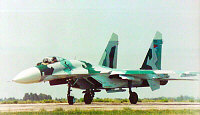 | ||||||||
| Service: | ~8x Su-27SK/Su-27UB | |||||||||
| On order: | - | |||||||||
| First delivered: | Summer 2003 | |||||||||
| Last delivered: | ? | |||||||||
| Information: |
At least one Su-27 single-seater and one Su-27UB two-seater have been supplied to Eritrea.
The Su-27UB aircraft was first spotted at the KnAAPO plant at
Komsomol'sk-on-Amur wearing the serial 608 at the top of the
fin in the same style as Eritrean MiG-29s. The 8 might suggest
that this is the 8th Su-27 in service. AFM has also published a photograph showing the Su-27UB on the flight line among several Eritrean MiG-29s in Eritrea, probably at the Asmara air base near the capital. Interesting is that the aircraft carries a similar splinter camouflage scheme as airshow demonstrator Flankers. A photograph showing a single-seat Su-27SK in Eritrean markings and with the same splinter camouflage can be found on the internet as well. | |||||||||
| 7. Ethiopia: BACK TO TOP | ||||||||||
| Delivered: | 11x Su-27SK, 3x Su-27S/P, 4x Su-27UB |  | ||||||||
| Service: | 11x Su-27SK, 3x Su-27S/P, 4x Su-27UB | |||||||||
| On order: | - | |||||||||
| First delivered: | November 1998 | |||||||||
| Last delivered: | 2003-2004 | |||||||||
| Information: |
In 1998 Russia started to export former Russian
Su-27s abroad, that had became available after the integration of the
Air Defence Forces and the Air Force. Also it would raise
funds for the Ministry of Defence to upgrade and replace
the existing fleet. Ethiopia was the first customer
and in late 1998 a contract was signed for six single-seat and
two twin-seat aircraft.
The first was delivered in November 1998. On 6 January 1999, one of the Su-27SK crashed while performing a demonstration flight. The aircraft was replaced by another one delivered from Russia. Since the service introduction in February 1999, the EtAF Su-27s have fought against Eritrean MiG-29s on several occasions in the second Ethiopian-Eritrean war (1998-2000). Five MiG-29s have been shot down, and one other MiG-29 was damaged and crashed during landing. According to official arms export data supplied by Russia, Ethiopia ordered another seven ex-Russian Air Force Su-27 Flankers in 2002. The aircraft believed to be five Su-27SK and two Su-27UB were delivered in 2003-2004. Ethiopia is also thought to have bought three Su-27s from the Ukraine. The Ethiopian Flanker fleet is reportedly based at Debre Zeyit. | |||||||||
| 8. India: BACK TO TOP | ||||||||||
| Delivered: | 18x Su-30K (Su-30MK), 38x Su-30MKI, 100+ HAL Su-30MKI | 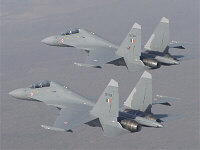 | ||||||||
| Service: | ~130x Su-30MKI (HAL/IAPO about 70/30) | |||||||||
| On order: | ~40x Su-30MKI (HAL), 40x Su-30MKI (HAL) | |||||||||
| First delivered: | Spring 1997 (Su-30K) 22 June 2002 (Irkut Su-30MKI) December 2004 (HAL Su-30MKI) late 2007 (Irkut Su-30MKI, Su-30K replacements) | |||||||||
| Last delivered: | 1999 (Su-30K) December 2004 (Irkut Su-30MKI) ~2008 (Irkut Su-30MKI, Su-30K replacements) ~2017-2018 (HAL Su-30MKI) | |||||||||
| Units: |
Central Air Command
15 Wing, Bareilly AFS, Uttar Pradesh 24 Squadron Hawks, 8 Squadron Eight Pursuits (2009) 2 Wing, Lohegaon AFS, Pune, West? 20 Squadron Lightnings, 12 Wing, 30 Squadron Rhinos, Bareilly AFS, Uttar Pradesh or Pune? Western Air Command 34 Wing, Halwara AFS 31 Squadron Lions, Halwara AFS / Jodhpur AFS? 220 Squadron Desert Tigers, Halwara AFS ?, West (2011) Eastern Air Command 11 Wing, Tezpur AFS 2 Squadron Winged Arrows, Tezpur AFS (2009) - , East 14 Wing, Chabua AFS, Guwahati 102 Squadron Trisonics, Chabua AFS - , East South Western Air Command 32 Wing, Jodhpur AFS 15 Squadron Flying Lancers (2012) Southern Air Command? 47 Wing, Tanjavur AFS, - , | |||||||||
| Information: |
On 30 November 1996 Russia and India signed a contract for the
delivery of 50 Su-30MK multi-purpose twin-seat fighters, also
known as Su-30MKI (I for India). The first eight aircraft
had capabilities as the Su-30K, the other ten had already some of the multi-role improvements added. The other 32 were Su-30MKI standard aircraft upgraded with thrust vectoring AL-31FP engines, improved avionics and canards (see variants). The first batch of ten Su-30MKI aircraft was delivered on 22 June 2002. Second batch counted 12 aircraft. The third and final batch of the initial order produced by Irkut consisted of ten aircraft and were delivered during December 2004. The Indian Air Force has 140 Su-30MKI aircraft on order for production under license by Hindustan Aeronautics (HAL). The initial batch of 26 aircraft were produced from assembly kits provided by Irkut, followed by by production from components. At HAL's Nasik plant, production started in 2004 and the first locally produced Su-30MKI was rolled out on 28 November 2004 and delivered in December 2004. Production is expected to peak at around 12 aircraft per year with final deliveries in 2017-2018. The Su-30MKI will become the mainstay of the Indian Air Force (IAF). The Su-30K aircraft were originally planned to be upgraded to MKI standard, but this plan was abandoned for financial reasons. Instead India ordered 18 additional new-built Su-30MKI from Irkut, putting the number of aircraft fully produced in Russia at 50. Russia will buy back the Su-30Ks for $12 million per aircraft, planning to upgrade them to Su-30KN and resell them (see Belarus entry). In December 2006, the Defence Acquisition Council granted approval for 40 additional Su-30MKI to be produced by HAL following completion of the standing order for 140 Su-30MKIs. However the contract still needs to be approved by the Finance Ministry and Cabinet Committee on Security and negotiations with Russia have to be finalized. The Indian Air Force had lost its first Su-30MKI in 2009. The first loss occured on April 30, 2009. The crew ejected, but the navigator died from his injuries. A second crash happened on November 30, 2009. Both crew members safely ejected. | |||||||||
| 9. Indonesia: BACK TO TOP | ||||||||||
| Delivered: | 2x Su-27SK, 2x Su-30MK, 3x Su-27SKM, 9x Su-30MK2 | 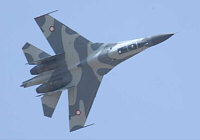 | ||||||||
| In service: | 2x Su-27SK, 2x Su-30MK, 3x Su-27SKM, 9x Su-30MK2 | |||||||||
| On order: | - | |||||||||
| Deliveries: | 2x Su-27SK: 27 August 2003 2x Su-30MK: 1 September 2003 3x Su-30MK2: 2 February 2009 3x Su-27SKM: 27 September 2010 6x Su-30MK2: 22 February 2013 - 6 September 2013 | |||||||||
| Serials: | Su-27SK/SKM: TS2701 -> TS2705 Su-30MK/MK2: TS3001 -> TS3011 | |||||||||
| Units: |
TNI-AU Wing 5 - Skadron Udara 11 (11th Air Squadron), Saltan Hassanuddin Air Base, Makassar, South Sulawesi | |||||||||
| Information: |
In 2003 the government of Indonesia ordered two Su-27SK (serial TS2701 and TS2702) single-seat
and two Su-30MK (serial TS3001 and TS3002) multi-purpose twin-seat aircraft to replace the ageing and gounded fleet of 20 A-4/TA-4 Skyhawks
of the Tentara Nasional Indonesia - Angkatan Udara (TNI-AU - Indonesian Air Force).
The order was part of a medium term plan to establish four new fighter squadrons before 2010, however
those plans were scaled down.
The Indonesian Su-30MK twin-seat aircraft were first reported to be designated Su-30KI, confusingly this designation had already been used for a new single-seat version specially developed for Indonesia. Indonesia had first signed a contract for 24 of these single-seat Su-30KI back in September 1997. However the contract was cancelled in 1998 as a result of the Asian economic crisis. Indonesia's Su-30MKs are KnAAPO built examples similar to China's Su-30MKK. The Indonesian Su-30MK are sometimes also referred to as Su-30MKI or Su-30MK(I), with the I clearly standing for Indonesia, and not referring to India's Su-30MKI version built by Irkut. In June 2006, it was announced that Indonesia planned to procure six additional Flankers from Russia. It was also made public that the four aircraft procured in 2003 had thus far been inactive awaiting upgrade of their communication systems, due to incompatibility with the Indonesian systems in use, and that no weapons had been bought to arm them. On 21 August 2007, on the opening day of MAKS 2007, Indonesia signed an agreement with Rosoboronexport for the purchase of three Su-27SKM upgraded multi-role single-seat export variants and three Su-30MK2 two-seat multirole derivatives built by KnAAPO, similar to those supplied to China, Vietnam and Venezuela. On the same day, Sukhoi also revealed it had signed a Memorandum of Understanding with Indonesia on the delivery of the six fighters. The value of the contract was reported to be USD 300 million. More than a year later, the order was formalised in November 2008, when Indonesia had finally secured sufficient financing to cover the deal. Two new Su-30MK2s arrived onboard an An-124 on December 26, 2008, at Saltan Hassanuddin air base, Makassar. The aircraft, with serials TS3003 and TS3004, were first flown from Saltan Hassanuddin on January 6, 2009, by a Russian pilot to test all on-board systems. The third and final Su-30MK2 (serial TS3005) also arrived by An-124 at the base on January 17, 2009. Following re-assembly and test flights, TS3005 was delivered on January 25, 2009. All three Su-30MK2s were subsequently formally handed over to the TNI-AU on February 2, 2009. The three Su-27SKM single-seaters (serials TS2703 thru TS2705) were delivered in September 2010, with the first two on September 10 and the final example on September 16. After the official handover on September 27, this completed the 2007 order. The three new Su-30MK2 two-seaters and three Su-27SKM single-seaters joined the two Su-27SK single-seaters and two Su-30MK two-seaters operated by the TNI-AU's Skadron Udara 11 at Saltan Hassanuddin air base. Six additional Su-30MK2 aircraft were ordered when a USD 470 million contract with Rosoboronexport was signed on December 29, 2011. Financing was finally secured in December 2012. The first pair, TS3006 and TS3007, arrived onboard an An-124 on February 22, 2013, at Saltan Hassanuddin air base, Makassar. The other two pairs were delivered in May and September of 2013. The six aircraft were reported to also join Skadron Udara 11. Over the years, officials of the Ministry of Defense of Indonesia have been quoted by the media to have big plans for the TNI-AU: concerning number of squadrons and additional Flankers, as many as 180, although more recently the country has been requesting second-hand F-16C/D fighters from the US as well. The next Flanker unit to be established is reportedly Skadron Udara 10. | |||||||||
| 10. Kazakhstan: BACK TO TOP | ||||||||||
| Delivered: | 36x Su-27P/Su-27UB | 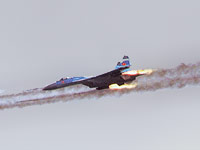 | ||||||||
| In service: | 28x Su-27P, 8x Su-27UB/UBM2 | |||||||||
| On order: | 22x Su-30SM | |||||||||
| Deliveries: | Su-27P/Su-27UB: 1996-1999 | |||||||||
| Serials: | ||||||||||
| Units: |
604th Air Base, Taldy-Kurgan (2012) detachment, 610th Air Base, Karaganda (2005) detachment, 612th Air Base, Aktau (2011) | |||||||||
| Information: |
Kazakhstan did not inherit Su-27 fighters, but they did
possess tactical strike and reconnaissance aircraft including
40 Tupolev Tu-95MS strategic heavy bombers. In a deal with
Russia the bombers were swapped for 27 MiG-29 and 16 Su-27 fighters
as well as some Su-25 attack aircraft. The first four Su-27s
were delivered in 1996. At least eight additional
Su-27s followed under military cooperation agreements. In November
1999 a contract was signed for 12 more Su-27s as payment for
Russia's debts. All single-seat Su-27s delivered to the Kazakhstan Air Defence Forces (Sil Vozdushnoy Oborony - SVO)are believed to be former PVO Su-27Ps. According to Letectví a kosmonautika [Müller & Büttner, 2006], the SVO had 28 Su-27Ps and eight Su-27UBs on strength in 2005. The Su-27s are stationed at the 604th Air Base, Taldy-Kurgan (Taldykorgan) but also have been reported to operate from the 610th Air Base at Karaganda, alongside the MiG-31s near the capital Astana, and at 612th Air Base near Aktau together with some Su-25s near the Caspian Sea [Müller & Büttner, 2006; 2007]. In 2011, the 612th Air Base at Aktau was reported to become a naval aviation base and had two SVO Su-27 stationed there. During KADEX 2012, the SVO showcased its Su-27UBM2 bort 50 Yellow, one of the first upgraded Su-27UB two-seaters. The upgraded aircraft was shown with a Litening targeting pod, the common R-73 and R-27 missiles but compared to contemporary upgrades lacked the RVV-AE (R-77) active radar seeking BVR missile. In 2015, Kazakhstan ordered 22 Su-30SM (Su-30SMK?) from Russia. | |||||||||
| 11. Malaysia: BACK TO TOP | ||||||||||
| Delivered: | 18x Su-30MKM | 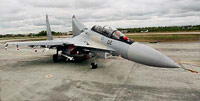 | ||||||||
| In service: | 18x Su-30MKM | |||||||||
| On order: | - | |||||||||
| Deliveries: | 18x Su-30MKM: 18 June 2007 - 17 August 2009 | |||||||||
| Serials: | Su-30MKM: M52-01 -> M52-18 | |||||||||
| Units: |
RMAF 11 Skn (11 Squadron), Gong Kedak | |||||||||
| Information: |
The contract for 18 Su-30MKM fighters was signed on 5 August 2003.
Pilot training in Russia reportedly started in early 2004 to train four pilots and two weapons system officers
who will become instructors. Two Su-30MKI pre-production aircraft (number 04 and 05)
had been converted to Su-30MKM prototypes for testing the integration of the new avionics.
Official handover of the first aircraft took place on May 24, 2007, when two Su-30MKM were officially
accepted by the RMAF at Irkut's facility in Irkutsk, Russia. The two aircraft (serials M52-01 and M52-02) were delivered to Gong Kedak AB, Malaysia,
on June 18 by an An-124-100, one day behind schedule. The second pair arrived in July/August 2007. During this time three Sukhoi test pilots were in Malaysia
to test fly the reassembled aircraft and undertake RMAF pilot conversion. The first five month conversion
training programme started in July 2007. By December 2007, Malaysia had taken delivery of six Su-30MKMs and six crews
were trained on the aircraft. Malaysia plans to train 72 officers as pilots and weapons system officers for the Su-30MKM,
some of which may undergo training in India. The 18th and last aircraft arrived on August 17, 2009, along with the
other three aircraft of the final batch. Malaysian Su-30MKMs carry serials M52-01 thru M52-18.
The Royal Malaysian Air Force plans to issue a new Request for Proposals for the acquisition of new multi-role combat aircraft to replace the current MiG-29N fleet, as part of the 2011-2015 Five-Year Plan. Rosoboronexport would propose the MiG-35, more Su-30MKM, or Su-35, while SAAB is expected to offer the Gripen NG. The Su-30MKMs will fulfil the air defence role when the MiG-29Ns retire, until their replacements have arrived. | |||||||||
| 12. Uganda BACK TO TOP | ||||||||||
| Delivered: | 6x Su-30MK2 | 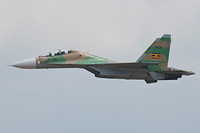 | ||||||||
| In service: | 6x Su-30MK2 | |||||||||
| On order: | (2x Su-30MK2 option, unconfirmed) | |||||||||
| Deliveries: | 6x Su-30MK2: July 2011 - June 2012 | |||||||||
| Serials: | Su-30MK2: AF011 -> AF016 | |||||||||
| Units: |
Uganda People's Defence Force Air Wing, Entebbe International Airport | |||||||||
| Information: |
In April 2010, Russian media reported that Rosoboronexport was negotiating a deal with Uganda for six Su-30MK2s for the
Uganda People's Defence Force. This was denied by Ugandan officials initially, but later stated to have been abandoned on
cost grounds.
In April 2011, the Ugandan government announced a contract with Russia for at least eight unspecified fighter aircraft and other military hardware worth $744 million. The contract included a firm order for at least six Su-30MK2. In July 2011, the first two Su-30MK2 were delivered by An-124 to Uganda, reportedly arriving on July 7th. One of the Su-30MK2 conducted what is believed to be its first post re-assembly test flight on 12 July 2011 over Entebbe. On July 25, 2011, the first official demonstration flight was undertaken for visiting President Museveni. Training of personnel had been stated to start soon. The second pair followed in October 2011, although it has been reported one safely crash landed at Entebbe airport on 24 November 2011. The delivery of the final pair was reported in early June 2012. The remaining two unspecified aircraft of the April 2011 contract may be an option for two additional Su-30MK2. The aircraft are painted in a sandbrown-lightgreen camouflage pattern. The first aircraft revealed carries serial AF011. | |||||||||
| 13. Ukraine: BACK TO TOP | ||||||||||
| Delivered: | 67x Su-27P/S, Su-27UB | 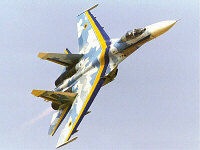 |
||||||||
| In service: | ~20x Su-27P/S/UB and 2x Su-27P1M/UB1M out of 57 total on record | |||||||||
| On order: | - | |||||||||
| Deliveries: | 1992* | |||||||||
| Serials: | ||||||||||
| Units: | 831 avbrv, Myrgorod | |||||||||
| Information: |
After the collapse of the Soviet Union, when Ukraine gained
its independence, it inherited some 1500 combat aircraft and
in March 1992 the Ukrainian Air Force was established.
The most up-to-date fighter among the inherited aircraft
was the Su-27, which remains the main fighter of the
Ukrainian Air Force today. The red star has been replaced by
national insignia which changed several times during the 90s.
One Su-27UB was lost after crashing during an airshow at the Ukrainian airbase of L'vov-Sknilov on 27 July 2002. The Su-27UB plunged into the crowd after hitting a parked aircraft and exploded in a ball of fire killing 83 and injuring 115 spectators. The pilot was arrested, the air force commander was sacked and three other senior officers of the 14th air corps were arrested. Ukraine exported some of its Su-27s. One of the most publicized sales involves two overhauled and demilitarized Su-27UB two-seaters, which were delivered to Pride Aircraft Inc of Rockford, Illinois. The aircraft were delivered in October 2008 at Rockford and subsequently upgraded with Western avionics. By October 2009, both aircraft were offered for sale on the US civil market. Today, the Su-27 remains in service with the Ukraine Air Force. 831 avbrv operates the aircraft at Myrgorod. The exact number of Su-27s in the Ukraine is reported as 57, although less than half remained in service. As a result of Russia's annexation of Crimea and subsequent outbreak of war in Eastern Ukraine the Ukrainian Ministry of Defence decided to return stored Su-27s to service with the overhaul implementing a small modernization upgrade of radar, navigation and communication equipment. The State Aircraft Repair Plant at Zaporizhzhya developed the upgrade in 2012 using Su-27UB '71 blue'. The MOD accepted the project officially on August 5, 2014. The full upgrade proposal also featured new components for the air-to-ground mission, but these have not been included as the Su-27s are primarily tasked with air defence. Aircraft with this first modification are designated with the -1M suffix. Su-27UB1M '71 blue' was handed over to the 831 avbrv in 2015, and followed by the first upgraded single-seater Su-27P1M. | |||||||||
| 14. Uzbekistan: BACK TO TOP | ||||||||||
| Delivered: | 25x Su-27P, 6x Su-27UB | 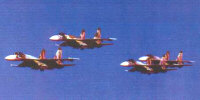 | ||||||||
| Service: | ~25x Su-27P/Su-27UB | |||||||||
| On order: | - | |||||||||
| Deliveries: | 1992* | |||||||||
| Serials: | ||||||||||
| Units: | 62 IAP, Andizhan | |||||||||
| Information: | Uzbekistan inherited about 300 aircraft including 31 Su-27 fighters from the 62nd IAP of the former Soviet Air Defence Forces (PVO) based at Andizhan. | |||||||||
| 15. Venezuela: BACK TO TOP | ||||||||||
| Delivered: | 24x Su-30MK2 | 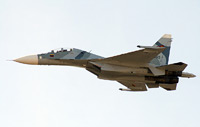 |
||||||||
| Service: | 24x Su-30MK2 | |||||||||
| On order: | - | |||||||||
| Deliveries: | 30 Nov 2006 ~ July 2008 | |||||||||
| Serials: | 0460, 1075, 1259, 1265, 8963 | |||||||||
| Units: | AMV - Grupo Aéreo de Caza 13 "Libertador Simón Bolívar", Base Aérea Teniente Luis del Valle García, Barcelona. | |||||||||
| Information: |
Venezuela placed an initial order for 24 Su-30MK2 Flankers on July 25, 2006, as part of a $3 billion weapons
contract which also included helicopters and other equipment. The
first two KnAAPO-built Su-30MKV (Su-30MK2 AMV) Flankers were delivered on November 30, 2006, and formally accepted on December 5 by the Venezuelan government-owned
Cavim weapons factory.
The two aircraft, serials 0460 and 1259, made
their first public debut at the 86th anniversary of the Venezuelan Air Force display at Base Aérea El Libertador in Maracay
on December 10, 2006. The Flankers are operated by Grupo Aéreo de Caza 13 "Libertador Simon Bolivar" based at Base Aérea Luis Del Valle Garcia in Barcelona.
A further two were delivered in late December, 2006, (serial 1265 and 8963), followed by four more in March 2007 (including 1075).
The last pair of the 24 aircraft was delivered in July 2008. The FAV is currently looking at the Su-35 to replace its Mirage 50s and reportedly a second batch of 12 Su-30MKV is also being considered. | |||||||||
| 16. Vietnam: BACK TO TOP | ||||||||||
| Delivered: | 7x Su-27SK, 5x Su-27UBK, 2x Su-27PU, 36x Su-30MK2V | 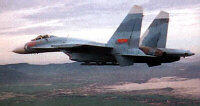 | ||||||||
| Service: | 6x Su-27SK, 3x Su-27UBK, 2x Su-27PU, 35x Su-30MK2V | |||||||||
| On order: | - (plans for Su-30SM and Su-35 export) | |||||||||
| Delivered: | 1st order: May 1995 - Dec 1996 (Su-27SK/UBK) 2nd order: Dec 1997 - June 1998 (Su-27SK/UBK/PU) 3rd order: Nov 2004 (4x Su-30MK2V) 4th order: 2011 (8x Su-30MK2V) 5th order: 2012-2013 (12x Su-30MK2V) 6th order: 2014-2016 (12x Su-30MK2V) | |||||||||
| Units: |
1994-2004: 937th Fighter Regiment, Phan Rang, Hua Giang. (Su-27SK/UBK) 935th Fighter Regiment, Bien Hoa, Dong Nai. (Su-27SK/UBK/PU Su-30MK2V) 2016: 923rd Fighter Bomber Regiment, Tho Xuan, Yen The. (Su-30MK2V) 927th Fighter Regiment, Kep, Lam Son. (Su-30MK2V) 935th Fighter Regiment, Bien Hoa, Dong Nai. (Su-30MK2V) 940th Fighter/Air Training Regiment, Phu Cat, Tây Sơn (Su-27SKM/UBK/PU) | |||||||||
| Information: |
Vietnam became the second Asian country to purchase the
Su-27 aircraft after China. In 1994, five Su-27SK and one
Su-27UBK were ordered. The first two aircraft arrived in May 1995, the remainder
had been delivered by late 1996 to the Vietnamese People's Air Force (VPAF). They equipped
the 937th Fighter Regiment based at Phan Rang air base in Hau Giang province.
In December 1996 an additional batch of two Su-27SK and four Su-27UBK was ordered. The single-seaters were accepted by the VPAF at Komsomolsk-on-Amur, Russia. In December 1997, the aircraft were airlifted to Phan Rang, shortly followed by the Su-27UBK two-seaters. However, the last two Su-27UBK were lost when the An-124 carrying the planes was lost in a fatal crash. Two Su-27PU (basic Su-30) were delivered as replacements six months later in June 1998. This second batch went to the 935th Fighter Regiment at Bien Hoa air base, Dong Nai province. One Su-27SK (6007) was lost in a crash in 1998. Later the Flankers of 937th Fighter Regiment at Phan Rang were also transferred to the 935th Fighter Regiment at Bien Hoa, consolidating the fleet at Bien Hao and to use Phan Rang to base ex-Polish Su-22M4/UM3K Fitters. In late 2003 a contract was signed for four slightly modified derivatives of the KnAAPO-produced Su-30MK2 two-seat multi-role fighter, which was developed for China. Modifications include an upgraded communications suite and improved ejection seats, as a result the Su-30MK2V designation appeared for the Vietnamese MK2s. In November 2004 KnAAPO delivered the Su-30MK2V fighters to the Vietnamese People's Air Force (VPAF). The 935th Fighter Regiment at Bien Hoa became the first unit the operate the Su-30MK2V. The initial Su-30MK2Vs sported a three-tone blue camouflage, somewhat similar to the Su-27SK/UBK. In January 2009, a follow-on contract was finally signed for eight more Su-30MK2s, previously reported as 12. Delivery in two batches of four in 2011, the first having been delivered in June. In addition to joining the fleet of 935th Fighter Regiment at Bien Hoa, the 923rd Fighter Bomber Regiment at Tho Xuan started its transition to the Su-30MK2. For the air-to-air roles, the VPAF purchased R-73 and R-27 missiles to equip its Flankers. The Su-30MK2V deal included Kh-31A anti-ship missiles and Kh-29 air-to-surface missiles. Unguided bombs and rockets were reportedly used in anger in July 2011 as a response to a naval clash with China. Later Vietnamese Air Force footage also revealed the R-77 having been delivered. Announced in June 2009, Vietnam also planned a further 12 Su-30MK2. The order was finally confirmed on February 10, 2011, the aircraft were delivered in 2012-2013. The aircraft received a new sandbrown/green camouflage. The 923rd Fighter Bomber Regiment at Tho Xuan became fully equipped with 12 aircraft and in 2014 started training 927th Fighter Regiment pilots. A third agreement for another dozen Su-30MK2 fighters was reported in mid-August 2013. The first four fighters were delivered by late 2014, four in 2015, and the final four slightly delayed in mid February of 2016. The 927th Fighter Regiment at Kep Air Base also equipped with the Su-30MK2. With the final delivery in 2016, the Su-30MK2 equipped three regiments each with 12 aircraft. Meanwhile the older Flankers were re-assigned to the 940th Fighter/Air Training Regiment (previously 925th) at Phu Cat. Repair and overhaul nowadays are performed in-country at the A32 factory facility at Danang. Upon completing the overhaul in 2016, Su-27PU number 8526 received the same sandbrown/greencamouflage as seen on the later Su-30MK2Vs. Likely, the initial Su-30MK2Vs are to follow suit, while it's thought that for the Su-27SK single-seaters a new two-tone blue camouflage is being trailed. On June 14, 2016, a Su-30MK2 (number 8585) of the 923rd Fighter Bomber Regiment was lost. | |||||||||
| Notes: BACK TO TOP | ||||||||||
|
* aircraft were inherited from the former Soviet Union ~ estimated + option ? unknown - none or not applicable / combination of both GvIAP = Guards Fighter Aviation Regiment HAL = Hindustan Aeronautics Ltd. (India) IAP = Istrebitel'nyy Avia Polk (Fighter Aviation Regiment) IAP0 - Irkutsk Aircraft Production Association, part of Irkut SPC, 13.2% owned by Sukhoi Sukhoi Company - Sukhoi holding company (JSC) Sukhoi OKB - Sukhoi Design Bureau (JSC), 50% +1 owned by Sukhoi KnAAPO - Komsomolsk-on-Amur Aircraft Production Association, 74.5% owned by Sukhoi NAPO - Novosibirsk Aircraft Production Association, 74.5% owned by Sukhoi | ||||||||||
| a. Iran: BACK TO TOP | ||||||||||
| Delivered: | - |  | ||||||||
| In service: | - | |||||||||
| On order: | - | |||||||||
| Deliveries: | - | |||||||||
| Information: |
In mid 2007, reports started to appear in the media that Iran was close to signing
an order with Russia's state arms export company Rosoboronexport for at least 250 Su-30MK variants.
However, at the Paris Air Show held in June 2007, Russian state arms export company Rosoboronexport CEO Sergei Chemezov said that Russia had no plans to sell MiG fighters to Syria and Iran. It is likely that the same applied to Sukhoi jets as Russia suspended its arms supplies to the Middle East following the 2006 conflict in Lebanon. | |||||||||
| b. | ||||||||||
| Delivered: | - | |||||||||
| In service: | - | |||||||||
| On order: | - | |||||||||
| Deliveries: | - | |||||||||
| Information: |
The Mexican Navy had selected Sukhoi’s Su-27 over the Saab/BAE Systems Gripen to equip its first air defence unit.
The new fleet of fighters would enable strategic surveillance over key areas of the Mexican coastline, such as the Bay of Campeche oil field.
In June 2006, it was reported that contract negotiations with Rosoboronexport
were underway to buy eight single-seat Su-27s and two Su-27UB dual-seat trainers. Although some sources suggested the deal
could be for up to 12 aircraft. On February 23, 2007, the Secretaria de Marine-Armada de Mexico (SEMAR - Secretariat of the Mexican Navy) announced that the plan to acquire Su-27s had to be abandoned due to budget constraints. SEMAR confirmed that lower cost alternatives, at the time rejected in favour of the Su-27 purchase, will have to be re-evaluated. [AFM #230] | |||||||||
| c. | ||||||||||
| Delivered: | - | |||||||||
| In service: | - | |||||||||
| On order: | - | |||||||||
| Deliveries: | - | |||||||||
| Information: |
Although Russia presented the Su-27 fighter on several occasions,
Syria never placed the order. On at least two occasions the Su-27s
carried 'full' Syrian Arab Air Force (SyAAF) markings and were flown
by SyAAF pilots for familiarisation and testing. However lack of funding and/or disputes about the payment of weapons delivered in the 1980s obstructed the deal. There were reports in January 2007 of a $1 billion deal with Syria similar to the one signed with Algeria in January 2006. The deal focuses on acquisition of new MiG-29M/M2 fighters and MiG-29SMT upgrades to the existing fleet. The deal has also been reported to include the MiG-31 and Su-30MK2. At the Paris Air Show 2007, RAC MiG deputy general manager Vladimir Vypryzhkin confirmed having received the first foreign order for the MiG-31 and MiG-29M/M2 fighter, he did not disclose further details. But he did not rule out the Middle East for future MiG-29 and MiG-31 deliveries. However, also at the Paris Air Show, Russian state arms export company Rosoboronexport CEO Sergei Chemezov denied the earlier reports, saying that Russia has no plans to sell MiG fighters to Syria and Iran. Russia suspended its arms supplies to the Middle East following the 2006 conflict in Lebanon and continued its policy of limiting options to 'defensive weapons'. The internal situation in Syria since 2011 made further developments unlikely, until Russia in 2015 deployed combat aircraft to Syria to aid president Assad, now it remains to be seen if the Syrian Air Force may be able to get the Flanker from Russia eventually. | |||||||||
| Sources: BACK TO TOP | ||||||||||
| view sources used | ||||||||||
| Comment: BACK TO TOP | ||||||||||
| Please send any corrections, updates or comments to webmaster@milavia.net | ||||||||||
Copyright © 2008-2016 Niels Hillebrand - MILAVIA.NET
| ||||||||||
 Back to Index

